

Medicine delivery app development is expanding due to urban lifestyles, aging populations, and mobile access. The global online pharmacy market grows at nearly 17% CAGR. Market value may cross USD 280 billion by 2029. Smartphone penetration exceeds 85% in developed regions. E-prescriptions adoption increased after post-pandemic regulations. An online medicine delivery app now demands speed, compliance, and trust. Users expect same-day fulfillment and verified pharmacies. Over 60% of patients prefer app-based refills. Chronic care users drive recurring revenue. Data security and regulatory alignment define long-term viability. Competitive gaps still exist in logistics and user experience.
This medicine delivery app development guide will help to build a compliant and scalable online medicine delivery app. It delivers a clear workflow, covering planning, tech stack, features, compliance, UX and scaling. You will learn how to outperform existing medicine delivery app solutions like PharmEasy and GoodRx by focusing on secure telepharmacy, fast fulfillment, and user-centric design.
What Is a Medicine Delivery App & How Does It Work?

A medicine delivery app enables users to order prescription drugs digitally. It connects patients, licensed pharmacies, and logistics systems through software. Most platforms operate as an online pharmacy app with regulated workflows. Medication delivery apps focus on verified prescriptions, controlled fulfillment, and tracked distribution. The system functions through the following coordinated user actions and backend validations.
- User searches medicines and uploads prescriptions
- Pharmacy verifies prescriptions and confirms medicine availability
- Delivery manages pickup, routing, and last-mile fulfillment
- Admin monitors compliance, orders, payments, and system controls
Prescription upload triggers automated checks. Pharmacists validate dosage and legality. Orders proceed only after approval. Every step is logged for audit and traceability.
Why Medicine Delivery Apps Are Booming in 2026
Demand for the online medicine delivery app model is rising worldwide. Convenience is the primary driver here. Users want faster access without pharmacy visits. Urban density and traffic increase reliance on digital orders. Chronic patients reorder medicines every month. The global e-pharmacy market reached USD 107.7 billion in 2024 and is projected to grow at 12.89% CAGR through 2033, according to IMARC Group.
Startups invest because apps that deliver medicine generate repeat usage. Prescription refills create predictable user demand. Logistics integration reduces fulfillment cost, while digital prescriptions shorten processing time. Also, a home delivery medicine app scales faster than physical chains due to lower overhead. Coherent Market Insights suggests that the online pharmacy market is expected to grow at 19.5% CAGR through 2032.
Here are the core reasons for rising medicine delivery app adoption:
- Benefit from high mobile health adoption
- Rising preference for doorstep medicine delivery
- Recurring demand from chronic care patients
- Startup scalability through digital fulfillment systems
Types of Medicine Delivery Apps
Medicine delivery apps differ by how medicines are sourced and fulfilled. Here, the medicine delivery app business model determines legal exposure, operational cost, and expansion speed.Global startups usually prefer speed, while enterprises focus on control and compliance.
Pharmacy Aggregator Model
The pharmacy aggregator model sits between customers and pharmacies. The app coordinates orders without touching medicines. This structure reduces capital risk and allows fast regional rollout.
- Pharmacy visibility: Users discover licensed pharmacies that can legally fulfill prescriptions in their area.
- Order coordination: The system passes orders to pharmacies, while packing and dispatch stay offline.
Single Pharmacy App
This model exists for one pharmacy brand. It helps to create a digital extension of an existing store through a dedicated application. The growth of single pharmacy apps depend on opening new stores, not app downloads.
- Inventory ownership: The pharmacy manages stock, substitutions, and pricing directly.
- Prescription handling: Verification and dispensing follow internal pharmacy workflows.
- Delivery scope: Orders are fulfilled within a fixed service radius.
Marketplace + Inventory Model
This hybrid model combines aggregation with owned stock. It is common in enterprise-scale operations and requires strong capital backing.
- Central stock control: The platform stores essential medicines to ensure availability.
- External pharmacy coverage: Partner pharmacies fill gaps if warehouses cannot serve.
- Operational trade-off: Faster delivery comes with higher compliance and logistics effort.
Hospital-Integrated Medicine Delivery App
This model connects clinical care directly to fulfillment systems. It is also common in enterprise healthcare systems supporting long-term treatment continuity.
- System-level integration: Prescriptions flow from hospital software into the delivery pipeline.
- Post-care fulfillment: Medicines are dispatched after discharge or consultation.
- Adherence support: Patients receive medicines without additional pharmacy visits.
Must-Have Features in a Medicine Delivery App
A scalable medicine delivery platform depends on role clarity and operational safeguards. The must have features in a medicine delivery app are those that prevent order failure, regulatory breaches, and delivery delays. These medicine delivery app features must work under real-world load, not demos.
User App Features
- Prescription upload: Users submit prescriptions using camera capture or file upload with clarity checks.
- Medicine availability view: The app reflects pharmacy-level stock to reduce order rejection.
- Secure payment gateway: Payments support retries, partial refunds, and failed transaction recovery.
- Order lifecycle visibility: Users see each stage, from pharmacist review to dispatch.
- Delivery tracking: Real-time rider movement is shown after pickup, not before.
Pharmacy Panel Features
- Pharmacy onboarding: License validation, service zones, and fulfillment rules are configured during setup.
- Prescription review controls: Pharmacists approve, reject, or request clarification without leaving the panel.
- Order management system: Orders move through acceptance, packing, substitution, and handover stages.
- Inventory exposure logic: Stock visibility updates dynamically to avoid overselling regulated medicines.
Delivery Agent App Features
- Order acceptance flow: Agents confirm availability before pickup to avoid failed deliveries.
- Navigation support: Routes adapt based on traffic and pharmacy readiness.
- Delivery proof capture: Timestamped confirmation records protect against disputes.
Admin Dashboard Features
- System-wide order oversight: Admins monitor bottlenecks across users, pharmacies, and delivery agents.
- Pharmacy performance tracking: Rejection rates, delays, and compliance flags are visible.
- Payment settlement controls: Commissions, pharmacy payouts, and refunds are reconciled centrally.
- Audit and compliance logging: Every prescription action and status change is recorded for traceability.
Step-by-Step Medicine Delivery App Development Process
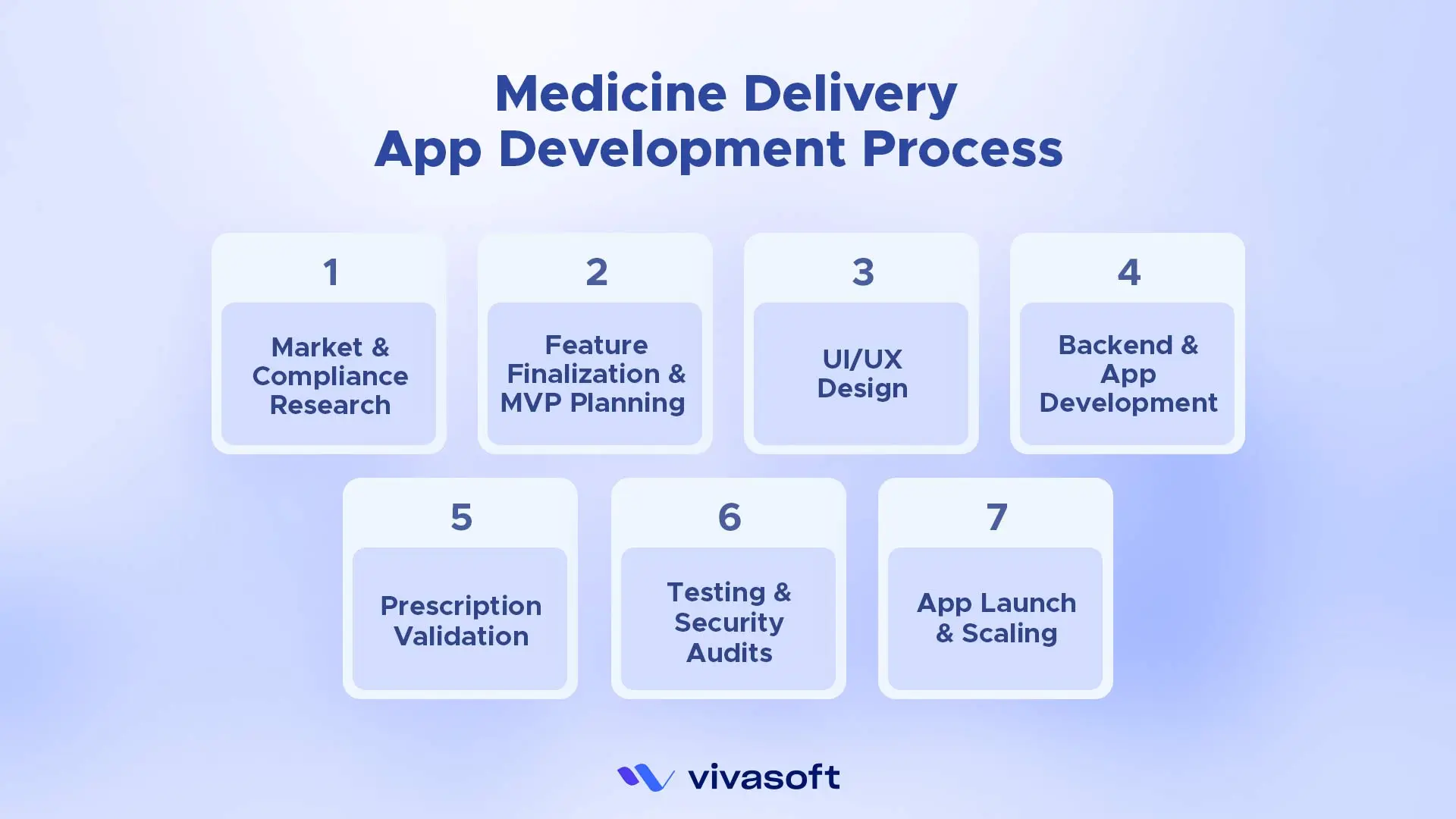
The steps to develop a medicine delivery app include market and compliance research, MVP planning, UX design, backend and mobile development, prescription validation, security testing, and controlled scaling. Below is the medicine delivery app development process used by successful global platforms. Here, you will learn how to create a medicine delivery app with clarity and execution focus.
Step - 1: Market & compliance research
Start by validating demand and regulations together. Medicine delivery fails without legal alignment. Study prescription laws, data privacy rules, and drug control policies per region. Analyze how existing apps handle prescriptions, fulfillment, and liability gaps. This step defines whether your idea is even buildable. The key focus areas while researching are:
- Drug sale regulations and e-pharmacy laws
- Data protection and health privacy rules
Step - 2: Feature finalization & MVP planning
Define what the first version of the medicine delivery app must do reliably. Avoid copying competitor feature lists blindly. Focus on flows that reduce order rejection and prescription failure. Create a MVP plan to decide cost, timeline, and compliance scope.
Step - 3: UI/UX design
Design for speed and clarity. Users should upload prescriptions without confusion. Pharmacies must review orders quickly. Delivery flows should minimize rider errors. Good UX reduces support tickets and failed deliveries early. Here are the design priorities while building a medicine delivery app:
- Prescription upload clarity
- Simple order status visibility
- Pharmacy-side action efficiency
Step - 4: Backend & mobile app development
Build the app system in layers. Backend handles orders, users, pharmacies, and deliveries. Mobile apps consume stable APIs. Architecture should support growth without rewrites. Building a medical app is a technical discipline.
Step - 5: Prescription & compliance validation
Prescription and compliance validation must enforce HIPAA safeguards. Access controls, encrypted storage, and audit trails are required when handling protected health information. Controlled drugs require extra safeguards. Pharmacist actions, prescription status changes, and user access must be logged for compliance review. Weak validation structure exposes the platform to legal shutdowns.
Step - 6: Testing & security audits
Test beyond basic functionality. Simulate failed payments, rejected prescriptions, and delayed deliveries. Run security reviews on data access and storage. Healthcare apps break trust fast when breaches occur.
Step - 7: App launch & scaling
Launch with limited geography or pharmacy partners. Monitor order or request failure rates closely. Scale the app functionalities only after workflows stabilize. Add pharmacies, riders, and regions gradually. Growth without control increases compliance and operational risk.
Technology Stack for Medicine Delivery App Development
In practice, the right stack is the one that survives regulatory load, traffic spikes, and operational mistakes. For regulated platforms, medicine delivery app development solutions should prioritize proven tools over trendy ones.
Frontend
- React or Next.js (web panels): Used for predictable routing and clear separation between user, pharmacy, and admin views.
- Flutter or React Native (mobile apps): Chosen to reduce maintenance overhead while keeping release cycles short.
- Accessibility-driven UI: Large touch areas and readable forms help older users complete prescriptions.
- Inline validation layers: Errors are caught before submission, not after rejection.
Backend
- Node.js with NestJS: Brings structure to APIs without slowing iteration.
- Java Spring Boot: Often selected by enterprises for long-term stability and strict contracts.
- Domain-isolated services: Orders, prescriptions, delivery, and payments run independently.
- Background workers: Notifications, retries, and delayed actions run outside request cycles.
- Idempotency handling: Prevents duplicate orders during retries or network failures.
- Graceful degradation logic: Keeps the app usable when external services fail.
Database
- PostgreSQL: Stores orders, users, pharmacies, and financial records reliably.
- Redis: Reduces load by caching availability and session data.
- Encrypted object storage: Holds prescription images and documents safely.
- Immutable audit records: Historical data is preserved for compliance review.
APIs
- REST APIs for core flows: Predictable behavior matters more than flexibility.
- Payment gateway integrations: Handle authorizations, refunds, and settlements.
- Logistics and mapping APIs: Power delivery routing and real-time tracking.
- E-prescription integrations: Added only where digital prescribing is allowed.
- Strict versioning rules: Prevent silent breakage during updates.
Cloud & hosting
- AWS or Google Cloud: Preferred for regional isolation and compliance tooling.
- Docker-based builds: Ensure consistent deployments across environments.
- Kubernetes only when needed: Introduced after traffic and services justify it.
- Continuous monitoring: Flags abnormal latency and failure patterns early.
Security tools
- Role-based access control: Limits who can see prescriptions and financial data.
- Short-lived authentication tokens: Reduces damage from leaked credentials.
- Encryption at rest and in transit: Protects all health-related data.
- Secrets vaults: Keeps keys and tokens out of source code.
- Tamper-resistant audit logs: Records every sensitive system action.
- Periodic access reviews: Removes stale permissions before they cause risk.
Healthcare Compliance & Legal Requirements
Medicine delivery apps operate inside regulated healthcare and pharmacy systems. The applicable rules depend on how the app handles prescriptions, patient data, and regulated drugs. In the USA, compliance usually involves HIPAA, federal drug laws, FDA software guidance, and state pharmacy regulations. Missing even one layer can block launch or trigger enforcement.
HIPAA is mandatory only when the app acts as a business associate or covered entity. If the platform stores, processes, or transmits protected health information on behalf of a pharmacy, hospital, or insurer, HIPAA applies. Once HIPAA applies, security safeguards, audit trails, and contractual BAAs are not optional.
Core USA regulations that apply
U.S. compliance combines HIPAA rules, federal drug laws, FDA guidance, and state pharmacy regulations.
- HIPAA compliance (HHS): Governs storage, access, and transmission of patient health data. Apps must implement administrative, technical, and physical safeguards.
- HIPAA Security Rule updates: HHS has proposed stricter cybersecurity and vendor accountability requirements. Platforms should design for stronger access controls and monitoring.
- FDA regulations (software functions): Ordering and delivery features are usually not regulated as medical devices. Features that diagnose, dose, or guide treatment decisions may fall under FDA oversight.
- DEA rules for controlled substances: Apps handling controlled-drug prescriptions must support EPCS workflows and identity verification standards defined by the DEA.
- State pharmacy board regulations: Each U.S. state controls pharmacy licensing, dispensing rules, and telepharmacy permissions. There is no federal shortcut here.
Practical Compliance Checklist for USA
Launching a medicine delivery app in the U.S. requires technical, contractual, and operational controls working together.
Confirm whether the platform is a HIPAA business associate
- Execute Business Associate Agreements with pharmacies and vendors
- Encrypt PHI at rest and in transit
- Implement role-based access and staff audit logs
- Support DEA-compliant EPCS if controlled substances are allowed
- Validate pharmacy licenses per operating state
- Maintain documented risk assessments and incident response plans
Europe (GDPR & Health Data Rules)
In Europe, medicine delivery apps handle special category data under GDPR. Health data requires stronger safeguards, explicit lawful basis, and strict access control. Unlike HIPAA, GDPR applies regardless of business role if EU residents are involved.
Practical Compliance Checklist for Europe
European compliance focuses on lawful processing, access control, and patient data rights.
- Identify lawful basis for processing health data
- Apply data minimization and purpose limitation
- Encrypt prescription data and restrict internal access
- Implement data subject rights handling workflows
- Store EU user data in compliant regions
- Maintain breach notification procedures within GDPR timelines
How Much Does Medicine Delivery App Development Cost?
The medicine delivery app development cost depends on scope, compliance depth, and geography. A simple MVP can be built within a modest budget, while a full-scale platform with logistics, compliance, and integrations costs significantly more. The cost to build a medicine delivery app rises when prescriptions, regulated drugs, and real-time delivery are involved. In healthcare, architecture and security decisions drive the healthcare app development cost as much as features.
MVP vs Full-Scale
| Scope | Cost Range |
|---|---|
| MVP (Basic ordering, auth, prescription upload) | $25,000 - $60,000 |
| Production (Native apps, logistics, pharmacy portal) | $100,000 - $450,000 |
| Enterprise (EHR connectors, warehouses, telepharmacy) | $400,000 - $1,000,000+ |
Feature-based Cost Breakdown
| Feature | Cost Range |
|---|---|
| User auth & onboarding | $2,000 – $8,000 |
| Prescription upload + OCR + review | $5,000 – $20,000 |
| EPCS / controlled-substance support | $5,000 – $25,000+ |
| Payments & refunds (PCI-ready) | $3,000 – $10,000 |
| Real-time tracking & driver app | $10,000 – $60,000 |
| Dispatch / routing engine | $8,000 – $40,000 |
| Inventory & warehouse management | $15,000 – $80,000 |
| Pharmacy portal | $8,000 – $35,000 |
| Telepharmacy / secure video consults | $12,000 – $60,000 |
| EHR / Epic / Cerner connector (per) | $25,000 – $150,000+ |
| HIPAA compliance uplift (percentage) | +15% – +30% |
Region-wise Development Cost
| Region | Hourly rate | Cost consideration |
|---|---|---|
| North America | $100 – $200 / hr | Higher labor cost, local compliance support. |
| Western Europe | $60 – $140 / hr | Strong engineering, regional compliance. |
| Eastern Europe | $35 – $75 / hr | Good mid-complexity value. |
| Latin America | $30 – $80 / hr | Nearshore option for US teams. |
| South Asia | $18 – $45 / hr | Lowest hourly band, good for MVP builds. |
| Southeast Asia | $20 – $50 / hr | Mixed capabilities, competitive pricing. |
How Long Does It Take to Develop a Medicine Delivery App?
The average development timeline for a medicine delivery app depends on scope and regulation, not just code volume. A basic MVP can move fast if compliance is limited. Timelines stretch when prescriptions, pharmacy workflows, and security reviews are involved. In practice, most teams plan in months, not weeks, and build in buffers for testing and approvals.
| Project Complexity | Estimated Duration | What’s included |
|---|---|---|
| Basic MVP | 3–4 months | User app, pharmacy panel, prescription upload, basic ordering, limited delivery flow |
| Market-ready product | 5–8 months | Polished UX, payments, delivery tracking, pharmacy onboarding, admin controls |
| Full-scale platform | 9–12+ months | Multi-role apps, inventory sync, routing logic, security hardening, QA cycle |
| Enterprise / regulated build | 12–18+ months | HIPAA workflows, EPCS, audits, integrations, staged rollout |
Factors that Influence Medicine Delivery App Development Timeline
Timelines change when requirements expand, approvals take longer than expected, or real-world workflows surface late in development. Here are the most common factors:
- Feature complexity: More modules (multi-role dashboards, real-time tracking, telepharmacy) extend development.
- Compliance & security: Healthcare apps undergo additional review and security hardening, which adds cycles.
- Platforms: Supporting both iOS and Android usually adds to duration compared with single platform builds.
- Testing & QA: Comprehensive testing in regulated sectors can span several weeks.
- Team setup: Distributed or offshore/onshore blends affect coordination and speed.
Monetization & Revenue Models for Medicine Delivery Apps
Medicine delivery apps earn from a mix of transactions, subscriptions, services, and partners. Revenue comes from per-order fees, premium user plans, pharmacy/B2B contracts, advertising and manufacturer programs, and value-added clinical services. The blend depends on geography, regulation, and whether the platform owns inventory or only coordinates fulfillment.
- Commission / transaction fees: Platforms take a percentage or fixed fee per order from partner pharmacies or sellers. This is common when the app lists multiple pharmacies and handles checkout and settlement.
Example: India’s aggregator models report commissions and delivery charges in their revenue mix (see PharmEasy). - Delivery fees & surcharges: Apps charge users per delivery or add speed/priority surcharges for same-day service. Fees vary by SLA and distance and often offset last-mile costs.
Example: Amazon Pharmacy offers low-cost same-day or low-fee delivery options tied to membership and orders. - Subscription / membership models: Flat monthly plans lock in recurring revenue and improve adherence. These plans can bundle refills, free delivery, and pharmacist support.
Example: Amazon’s RxPass is a $5/month benefit for eligible meds and Prime members. - Advertising & manufacturer programs: Platforms monetize placement, sponsored listings, and manufacturer-facing solutions. These go beyond simple display ads to programmatic manufacturer campaigns and point-of-sale offers.
Example: GoodRx reports growth in pharma manufacturer solutions and advertising revenue. - B2B / API & white-label services: Some companies sell pharmacy-as-a-service or white-label fulfillment APIs to clinics, telehealth firms, or DTC brands. This yields stable B2B revenue and scale advantages.
Example: Truepill offers API-driven fulfillment and white-label pharmacy infrastructure. - Value-added clinical & premium services: Revenue can come from paid telepharmacy, medication management, or clinical follow-ups. These increase lifetime value and justify higher margins.
Example: Telepharmacy programs improve adherence and can be billed or bundled with deliveries. (See telepharmacy studies and service offerings.)
Common Challenges in Medicine Delivery App Development & How to Solve Them
Most issues appear after development starts. Compliance gaps, workflow mismatches, and real-world pharmacy constraints surface once users and partners interact with the system. These medicine delivery app challenges are operational and they require design-level solutions.
- Prescription misuse and invalid uploads: Many users upload unclear or outdated prescriptions. This creates rejection loops and delays. Build guided prescription upload with previews, clarity checks, and pharmacist feedback loops. Pair automation with manual review to keep prescription verification reliable.
- Pharmacy onboarding friction: Pharmacies drop off when onboarding feels complex or time-consuming. Simplify onboarding with stepwise license verification and preconfigured service rules. Reduce setup effort without relaxing compliance checks.
- Healthcare data exposure risks: Weak access control or logging can expose sensitive data. This is a common early-stage mistake. Design role-based access from day one. Encrypt all health data and maintain audit logs. Strong healthcare app security is an architectural requirement, not an add-on.
- Order failures during peak demand: Stock mismatches and delivery delays increase when traffic spikes. Sync inventory frequently and introduce fallback routing to alternate pharmacies. Degrade gracefully instead of failing orders outright.
- Delivery coordination breakdowns: Riders arrive before orders are ready or miss priority deliveries. Link pharmacy readiness states to dispatch logic. Release deliveries only after packing confirmation to reduce idle time and errors.
- Regulatory surprises during expansion: Rules differ by state or region, and assumptions break when scaling. Consider compliance as modular. Isolate rules by geography and validate before expansion instead of retrofitting later.
Post-Launch Considerations After Building a Medicine Delivery App
After launch, real usage exposes weaknesses that never appear in testing. Live prescriptions, real pharmacies, and delivery pressure change system behavior. Post-launch work should focus on operations, reliability, and safety. This phase determines medicine delivery app scalability and the true cost of app maintenance. Following are the most common post-launch considerations:
Operational Monitoring & Issue Detection
Start with daily operational visibility. Track failed orders, prescription rejections, delayed deliveries, and payment errors. These indicators show friction before users complain. Monitoring should highlight abnormal patterns. Apps fail quietly when small issues accumulate unnoticed.
Prescription Handling & Compliance Control
Live usage introduces edge cases. Users upload unclear prescriptions. Cross-region orders appear. Pharmacist queues grow unexpectedly. Review rejection reasons regularly and adjust validation rules. Audit logs should be reviewed periodically, not only during incidents. Compliance must be maintained continuously.
Performance & Scalability Tuning
Early traffic is misleading. As usage grows, API latency, inventory sync delays, and background job congestion surface. Cache frequently accessed data. Tune queues and database indexes. Medicine delivery app scalability is about consistency under load, not peak numbers alone.
Pharmacy & Delivery Partner Performance
Partner behavior changes after onboarding. Some pharmacies delay confirmations. Some delivery agents ignore priority rules. Track partner-level metrics such as acceptance time and SLA breaches. Flag repeat issues early. Removing unreliable partners protects user trust more than adding features.
Security & Access Management
Post-launch growth increases risk exposure. New pharmacies, rotating delivery staff, and internal role changes require regular access reviews. Schedule security scans and penetration tests. Healthcare platforms attract attention once they scale. Security controls must evolve with usage.
Ongoing App Maintenance
Maintenance is continuous. Mobile OS updates, payment SDK changes, and third-party API updates can break workflows. Test critical paths before every update. Prepare fallback logic for external service failures. Silent errors damage credibility faster than visible downtime.
Measured Iteration After Launch
Post-launch feedback arrives fast. Do not build everything at the early stage. Prioritize fixes that reduce operational failures, improve compliance handling, or simplify workflows. In regulated products, stability improves retention more than cosmetic updates.
Final Thoughts
Launching an online medicine delivery app development project is easy to talk about and hard to execute well. The real challenge shows up after launch, when prescriptions vary, users behave unpredictably, and regulations leave little room for mistakes. Building a scalable & compliant medicine delivery app takes more than clean code. It takes experience with healthcare workflows and the discipline to plan for growth early. Teams that underestimate this usually struggle after launch. This is why choosing an experienced development partner matters. Working with an expert medicine delivery app development partner helps to anticipate risks, design for reality, and build a product built for real-world healthcare use.
FAQs
Do pharmacies get paid for delivering prescriptions?
Yes, pharmacies are paid when they offer delivery. Payment usually comes from delivery fees charged to customers or service agreements with delivery platforms. In some cases, pharmacies absorb the cost to retain customers, while others pass it through as a separate charge depending on location and policy.
Do I need an LLC to start a medicine delivery app?
An LLC is not legally required, but most founders choose one for liability protection. What matters more is proper registration, contracts with pharmacies, and compliance with healthcare and data laws. Entity type supports operations, but it does not replace regulatory obligations.
Who pays for prescription delivery?
In most cases, the patient pays for prescription delivery, either per order or through a subscription. Some pharmacies waive fees for regular customers, and certain insurance or healthcare programs may cover delivery for eligible patients, especially for chronic or elderly care.
What qualifications do medicine delivery drivers need?
Drivers usually need a valid license, a clean driving record, and a background check. Some platforms require basic training for handling medicines securely. Additional rules may apply for controlled substances, depending on local transport and pharmacy regulations.
Do you have to pay to have medication delivered?
Most services charge a delivery fee, though the amount varies by distance and urgency. Some platforms offer free delivery with memberships or minimum order values. Pharmacies may also provide free delivery as a customer retention strategy in competitive areas.
How to get paid to deliver prescriptions?
You can deliver prescriptions by partnering with a pharmacy or signing up with a delivery platform. After verification and onboarding, drivers are paid per delivery, per hour, or through incentives. Payment terms depend on the platform and local labor rules.
How to arrange medicine delivery?
Medicine delivery can be arranged through a pharmacy’s app, a medicine delivery platform, or by calling the pharmacy directly. The process usually involves submitting a prescription, confirming availability, selecting a delivery time, and completing payment or insurance verification.
How to develop a HIPAA compliant app?
To develop a HIPAA-compliant app, you must protect electronic protected health information (ePHI) through strong security, privacy, and compliance practices. This includes encrypting data at rest and in transit, enforcing role-based access controls, maintaining audit logs, signing Business Associate Agreements (BAAs) with vendors, and following HIPAA’s Administrative, Physical, and Technical Safeguards. Secure infrastructure, regular risk assessments, and ongoing compliance monitoring are essential throughout the app lifecycle.
For a step-by-step breakdown, see our HIPAA compliant app development guide.