

The healthcare industry is experiencing its biggest transformation in a century. Patients are becoming digitized and demanding instant access to care through their smartphones. Keeping users’ needs in mind, the health industry focuses on providing digital solutions for medical services, combining all the services online.
Now, patients are not only connected with the doctors remotely, but also they are educated on self-care. Even doctors manage patient records efficiently. Telehealth usage surprisingly stabilized at around 38 times higher than pre-pandemic levels. The global mHealth app care market is worth about 40.65 billion in 2025, which is expected to grow to around USD 88.70 billion by 2032.
But as with this advancement, a major concern is that approximately 71% of healthcare apps have at least one high-level security vulnerability. Even worse, 91% use weak encryption that leaves patient data exposed to hackers.
To assist you in overcoming these complexities, we are here with this comprehensive healthcare app development guide. You will get to know everything about building a secure HIPAA-compliant healthcare app and lead the industry.
Key Takeaways
- Healthcare app development requires strict regulatory compliance, including HIPAA or FDA approval.
- AI-based features like chatbots and predictive analytics in the healthcare app improve patient engagement.
- Subscription models in the apps help generate more stable revenue compared to pay-per-use or in-app purchases.
- Partner with an experienced healthcare development team to prevent costly mistakes and ensure compliance from the start.
How Healthcare App Development Is Different from Regular App Development
Healthcare software development focuses on strict regulatory compliance and health-related data security instead of just simple user engagement. The true value lies in safeguarding sensitive patient information, along with ensuring essential integration with the complex medical ecosystem.
Here’s a quick comparison table that clearly highlights healthcare apps vs. regular apps to show the difference.
| Factor | Healthcare App | Regular App |
|---|---|---|
| Compliance Requirements | HIPAA, FDA, GDPR, and state medical laws are mandatory | General data protection laws, app store guidelines only |
| Data Type Handled | Protected Health Information, or PHI, medical records, and diagnoses | Personal preferences, user-generated content, behavioral data |
| Security Standards | Enterprise-grade encryption like AES-256 and audit logs. Also, multi-factor authentication is required | Standard security |
| Approval Process | FDA premarket review for medical devices and HIPAA compliance audits | App store review only, which takes 1-7 days |
| Risk Level | High, as an error can cause patient harm or death | Low to medium. Here, errors cause user frustration |
| Development Cost | $140,000-$250,000. But compliance can add an additional 20-30% | $30,000-$80,000 for similar features |
| Testing Requirements | Clinical validation, compliance testing, security audits (10-15% of budget) | Standard QA testing (5-8% of budget) |
| Data Storage | HIPAA-compliant servers | Standard cloud hosting, where no special agreements |
Types of Healthcare Mobile App Development (Use-Case Based)
There are different types of healthcare apps designed for specific medical needs. Currently, you will find more than 350,000+ apps in total related to health on the global market. Each of the healthcare apps serves a different purpose in the healthcare ecosystem.

Patient-Centric App Development
A patient-centric app is a digital platform that is designed to let users manage their healthcare journey. Users can book appointments, track medications, and even see their test results on one virtual platform. It reduces the paperwork and waiting room hassle. Patients find the best medical care directly on their phone.
- Appointment Scheduling & Management Apps: The application is designed for scheduling appointments and virtual consultations. It also makes the follow-ups easier.
- Personal Health Record (PHR) Apps: Through these applications, patients can control their complete health record and access or share it securely anytime.
- Medication Management & Reminder Apps: Apps automate reminders to take prescribed medications. Patients can track dosage amounts and prevent errors.
- Mental Health & Mindfulness Apps: Through these mental health apps, patients can access meditation sessions and mood tracking tools to manage their mental health.
- Health Lifestyle Apps: The app helps users achieve and maintain healthy lifestyles through personalized goals.
- Pregnancy and Maternity Apps: These pregnancy tracking apps guide expectant mothers from conception through childbirth and postpartum recovery.
Real-World Examples & Revenue
- MyChart: MyChart has been downloaded over 10M+ times, with an average rating of about 4.0 out of 5 stars based on 200,000 ratings.
- Zocdoc: It is another digital health management platform that has generated around $150.2 million in revenue in 2025. It facilitates 6 million users booking appointments with doctors in 2,000+ cities across the United States
Doctor & Clinical App Development
This range of apps is another digital tool designed for healthcare professionals, like “doctor appointment app development” These integrated tools offer quick access to drug information or the needed diagnostic guidelines, making the decision easier. The apps often include collaboration features, where doctors can consult with colleagues and share information safely. The goal is to help doctors make accurate decisions faster and save time.
- Clinical Decision Support Apps: The app offers immediate, accurate medical information at the point of care. Doctors can make informed decisions in emergencies.
- Drug Reference Apps: The apps include detailed information on medicine, including dosing and adverse reactions. Doctors can verify safe prescriptions for multiple medications.
- Medical Calculators: Through these specialized apps, physicians can calculate dosages and prevent costly errors.
- Medical Networking Apps: The app includes in-app messaging and video calls, through which doctors can schedule appointments and provide medical consultations.
Real-World Examples & Revenue
- Epocrates: This is the famous app among physicians and other healthcare professionals for use at the point of care. The app has already generated approximately $500,000 in revenue with around 10k downloads.
- Doximity: This is the secure digital platform that serves more than 80% of U.S. physicians, along with 50% of NPs and physician assistants. The app has generated around $136.8 million in Q2 fiscal 2025.
Hospital & Enterprise App Development
Hospital and enterprise apps are large, all-in-one digital systems that are designed for entire healthcare facilities. It is likely an all-in-one CMS platform managing medical records, billing, staffing, inventory, and patient flow. Starting from doctors, administrators, and patients can share information quickly and coordinate care.
- Hospital Management Systems: The system includes all the needed features from billing management to clinical reporting and staff payroll.
- Electronic Health Records: EHR solutions store all patient data in one place, offering instant access to healthcare providers and medical staff.
- Pharmacy Management Systems: This specialized system helps pharmacies handle medication management and track inventory.
- Medical Imaging and Radiology Apps: The applications help radiologists view, analyze, store, and share diagnostic images efficiently.
Real-World Examples & Revenue
- Epic Systems: This is the widely used healthcare software that serves over 325 million patients. The app already hit $5.7 billion in 2024, up from $4.9 billion in 2023.
- MEDITECH: It is another popular hospital and enterprise EHR software that holds approximately 11.9% to 13.2% of the U.S. hospital EHR market share. The software system serves over 2,300 healthcare institutions globally.
Wellness & Fitness App Development
Wellness and fitness apps are designed to monitor physical activity and mental health. These digital platforms include specific tools, including logging workouts, counting calories, and meditation guidance, which enhance personalized health care. Users can make healthier choices and monitor their progress.
- Nutrition & Meal Planning Apps: These food tracking apps include wellness tools where users can track calories, macros, and meals, and ensure balanced nutrition.
- Sleep Tracking Apps: Users can get access to know their sleep cycle and track sleep duration and quality.
- Activity & Step Trackers: Users track daily activity and workouts, and view progress toward daily goals.
- Weight Management Apps: Apps help users set weight loss or gain goals with personalized calorie targets and progress tracking.
- Hydration Tracking Apps: Through these water intake tracking apps, users can set goals, send reminders, and log their water intake for better health.
Real-World Examples & Revenue
- MyFitnessPal: This famous fitness and health app already has about 200 million users, with revenue generated of around $310 million in 2023. In January 2024, it is one of the leading fitness and sports mobile apps, generating in-app revenues of more than $12 million in the U.S.
- Calm: It is the #1 mental wellness app designed to help people improve sleep and reduce stress. It has revenue of about $596.4M in 2024, up from $355M in 2022. Currently, over four million users subscribe to Calm.
Healthcare Mobile App Development: Step-by-Step Process
Every healthcare app starts with an idea. But ideas alone don’t guarantee success. With the proper healthcare app idea validation, you can minimize the chances of costly failure and lead the process to success. Follow this:
Step 1: Define the Problem You're Solving
Your healthcare strategy must start with clarity. For this, identify what exact health issue you’re addressing. You can conduct interviews with 15-30 potential users.
Use surveys for collecting broader data. Speak with doctors as well to understand their current issues. Research which CPT or HCPCS codes apply to your solution.
Step 2: Conduct Market Analysis & Map Stakeholder Workflow Integration
You have to conduct thorough market research and analyze competitors to find out the gaps your healthcare app can fill. Understand where your app fits in existing clinical workflows. Fix the integration planning, including EHRs, scheduling platforms, and billing software.
Step 3: Validate Clinical Evidence Requirements Early
Before you launch your healthcare app, it’s important to validate your medical features. Often, the inaccurate claims lead to legal issues and safety risks. That’s why it’s important to determine what clinical evidence is needed.
Like whether your app requires only observational data or formal clinical studies. Partner with healthcare institutions during development to ensure expected clinical outcomes. It also improves trust and speed of validation.
Step 4: Build and Test Your Minimum Viable Product
Now is the time to test your app’s core features before full-scale development. Include only essential features that solve the core problem. Also, launch for a small user group first. Ensure to conduct thorough testing of the MVP to gather valuable feedback and make necessary improvements. Test with each stakeholder group separately.
Step 5: Plan Regulatory and Prescriber Strategy
Healthcare requires effective regulatory compliance, approval with documented test evidence, and risk assessment. For this, you can start by studying apps similar to yours that have already succeeded.
Collect information from their regulatory plans. While developing the app, partner with doctors, nurses, and other healthcare providers as influencers. A recent survey shows that 55% of users had an app recommended by a health or care professional.
Core Features of a Healthcare Mobile App Development
Every successful healthcare app shares essential building blocks. Some of the must-have features include user registration, appointment scheduling, telemedicine consultations, EHR integration, and so on.
Must-Have Features
Here is the comprehensive list of the must-have healthcare app features you should know:
1. User Registration & Profile Management
The app should integrate an easy sign-up process with email, phone, or social media accounts. Patients can create profiles with personal and health information. Doctors can easily show credentials and specializations to improve trust. It also improves future interactions.
2. Appointment Scheduling & Calendar Management
The global online scheduling software market size is projected to grow from $546.1 million in 2025 to $1,518.4 million by 2032. So your app must have features to let users book appointments anytime via web or mobile apps. For this, include calendar synchronization, reminders, and confirmation notifications.
3. Telemedicine & Video Consultations
Around 72.2% of patients report that they would prefer an online visit or telephone visits in the future for non-urgent follow-ups. Your telemedicine app should offer remote patient monitoring with real-time video meetings. It is important for rural or underserved areas.
4. Secure Messaging & In-App Communication
The in-app communication tools facilitate ongoing communication without scheduling full appointments. It offers quick check-ins and efficiency in emergencies. It is even more important, as about 61% of patients over 35 years old report their preferred method of contact is to text their doctors for consultations.
5. Electronic Health Records (EHR) Integration
The users should securely store and access their health records within the app. It helps connect with existing hospital systems and offers quick data exchange. For this, it must ensure compliance with healthcare data privacy regulations.
6. Prescription Management & ePrescribing
This is the key feature so doctors can electronically prescribe medications. Digital prescriptions reduce errors and connect directly with pharmacies. Even patients can get instant medication instructions after consultations.
Note: ePrescribing is widely used to reduce the types of errors caused by “bad handwriting.” Reports have proved that the move to online prescribing is credited with reducing general medication errors by up to 50% to 55%.
7. Payment Gateway Integration
The app should include integrated payment systems to automate invoices for every patient. The system should generate pay slips for hospital staff and maintain payment records. This is important to ensure hassle-free transactions and transparent billing.
8. Ratings & Reviews System
The app users should have complete freedom to review their physicians and add feedback. This builds transparency and helps new patients choose suitable doctors. Doctors can also maintain high service standards.
Advanced Features
Now we are going to highlight more specific innovative features to make your health app smarter, more efficient, and future-ready.
1. Blockchain-Enabled Medical Records
The worldwide blockchain integration in healthcare has reached around $3.04 billion in 2025. It is projected to reach around $11.04 billion by 2029. Blockchain helps store medical records using decentralized ledger technology. It helps safeguard and secure medical records.
2. IoT & Remote Patient Monitoring (RPM) Integration
This specified feature helps healthcare apps connect with wearable devices and medical sensors. These devices constantly track critical signs and send information to doctors without a physical visit. Currently, the healthcare IoT market exceeds 500 million connected devices worldwide.
3. AR/VR for Medical Training & Surgical Planning
Health apps are now integrating innovative AR/VR features to ensure 3D environments in the healthcare setting. Basically, this is where medical students and healthcare professionals can train. It facilitates visualization of anatomy in a realistic setting. Doctors now prefer these apps for better surgical planning without the risk of errors.
4. Voice-Enabled AI Clinical Documentation
Through voice-enabled AI features, doctors speak naturally during patient visits, and the app automatically turns the conversation into structured medical notes. The system works in the background, recording key details without manual typing. Along with saving time, it offers more accurate clinical documentation.
5. Predictive Analytics
Health apps now utilize machine learning to analyze patient data. This can read medical history, lab results, and any major signs. Healthcare teams take advantage of it to identify health risks before symptoms become serious. To date, around 66 percent of U.S. healthcare organizations currently utilize predictive analytics.
6. AI-Powered Chatbots & Virtual Health Assistants
These widely used tools provide 24/7 patient support, answering medical questions and scheduling appointments instantly. They reduce workload for front-desk and clinical staff and improve patient engagement.
Note: Weill Cornell Medicine reported a 47% increase in appointments booked digitally via AI chatbots. The market has already reached $1.2 billion in 2024-2025 and is expected to grow three-to-fourfold by 2030.
7. Digital Therapeutics
These are FDA-cleared software programs designed to treat medical conditions using digital interventions instead of traditional drugs. They are used to treat conditions like anxiety, depression, and diabetes. They are prescribed by clinicians and help patients improve health outcomes.
| Feature | Innovation Level | Implementation Complexity | Priority for MVP |
|---|---|---|---|
| Blockchain Medical Records | High | High | Medium |
| IoT & Remote Patient Monitoring | High | Medium | High |
| AR/VR Training & Surgical Planning | Medium | High | Low |
| Voice-Enabled AI Clinical Documentation | High | Medium | High |
| Predictive Analytics | High | Medium | Medium |
| AI Chatbots & Virtual Assistants | Medium | Low | High |
| AI Chatbots & Virtual Assistants | High | Medium | Medium |
MVP Features & Prioritization Framework
To make your healthcare MVP development successful, focus on the features that provide immediate value and are critical to user experience:
- Secure User Authentication: The app should include strong security protection from day one. Include multi-factor authentication and password recovery for ultimate data protection.
- Appointment Booking System: Add functionality for users to book, reschedule, and cancel appointments with healthcare providers. Also, complete calendar integration and reminders to make the process much more efficient.
- Basic Medical Records Access: Though full EHR integration will come later, add read-only access so that the reader can see test results and medical history.
- Payment Processing: Focus on adding the basic payment functionality so that users can access and complete the payment securely and comfortably.
- Secure Messaging & Notifications: Your healthcare MVP should add secure messaging options for quick communication and follow-ups.
Note: To avoid overbuilding and creating confusion, you can utilize some popular MVP development prioritization frameworks. For instance, you can start with the MoSCoW method.
The MoSCoW matrix breaks possible features into Must-Haves, Should-Haves, and Could-Haves categories. By using it, early-stage startups can easily avoid overbuilding MVP features and ensure successful validation with minimal resources.
MVP vs Full App Comparison Table:
Have this quick comparison table between MVP and full-scale development to decide which you should build first to save resources and time:
| Area | MVP Healthcare App | Full Healthcare App |
|---|---|---|
| Goal | Validate the idea and core value fast | Scale features and user base |
| Features | Only must-have functions | Advanced and extended features |
| Development Time | Short and focused | Longer, multi-phase |
| Cost | Lower initial investment | Higher overall investment |
| Compliance | Basic security & compliance | Full regulatory coverage |
| Integrations | Limited or partial | Full EHR, devices, third-party systems |
| Scalability | Minimal | Built for long-term growth |
How a Healthcare Mobile Application is Build?
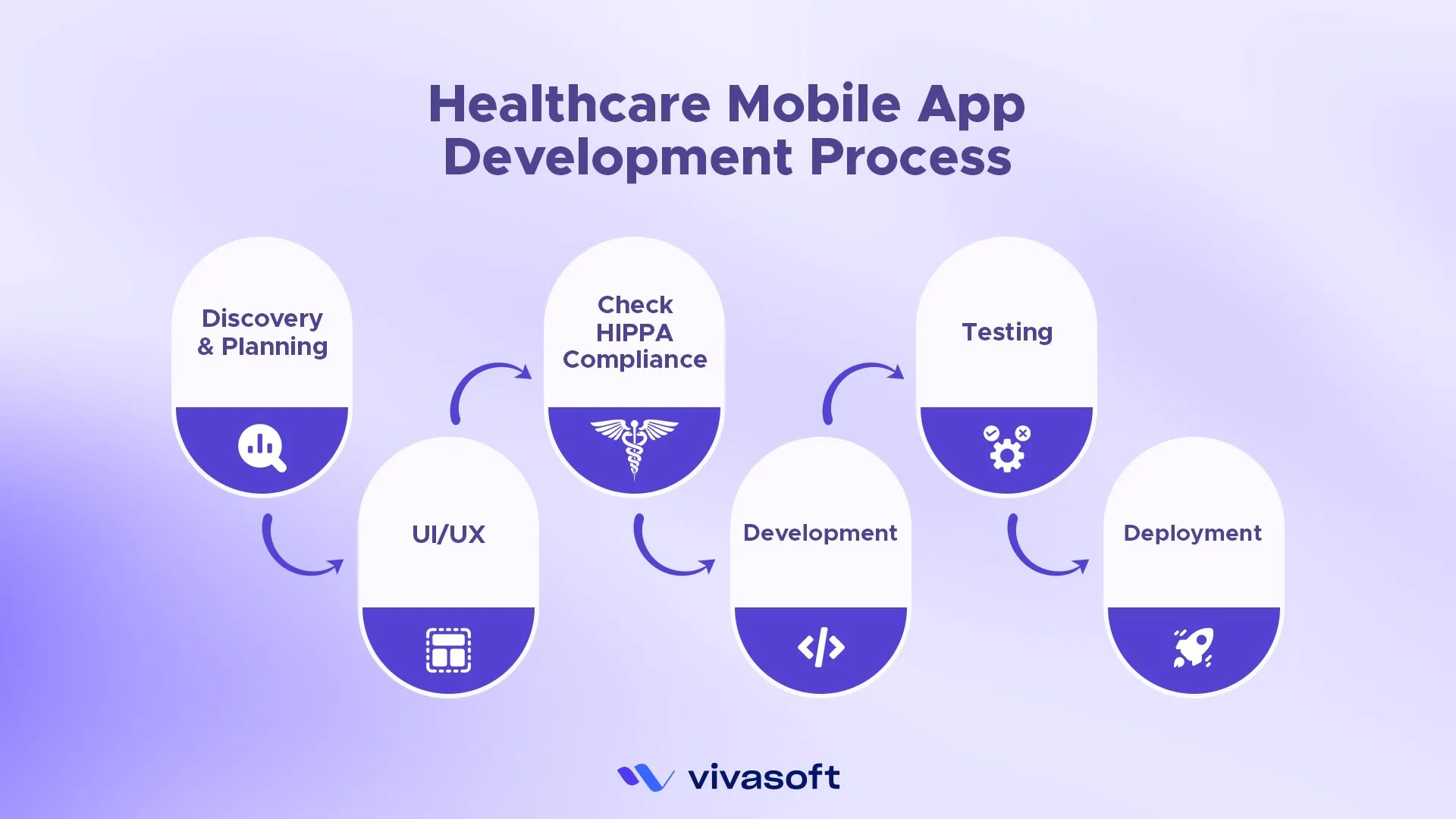
Here, you can follow the professional-guided healthcare app development process to actually build compliant apps.
Discovery & Planning
This phase is likely the blueprint for the development process and determines where the end product meets the users’ needs. Beyond just stakeholders, you have to connect with real users to understand their demands and pain points.
Create a detailed plan where you will document the project’s scope, objectives, timelines, and milestones. Professionals suggest mapping user journeys for each persona. You can take about 2–3 weeks to validate your ideas effectively.
UI/UX Design
Healthcare apps are not used only by technically enhanced people. You have to equally target elderly patients, busy doctors, and users with disabilities. That’s why your app interface should not feel complicated. It must be fast and obvious.
Start with creating efficient wireframes first, and then build interactive prototypes for usability testing. Through these mockups, users can test the flow early and give feedback more easily.
Check HIPAA Compliance
Compliance plays a notable role in an app’s overall success. You must follow all required regulations and ensure your solution includes strong security measures, such as data encryption and regular security audits.
Healthcare applications must comply with HIPAA, GDPR, FDA regulations, and other regional healthcare requirements to avoid legal risks and penalties. To better understand these requirements, you can explore this detailed guide on HIPAA-compliant app development.
Development (Frontend + Backend)
With compliance architecture in place, you have to focus on coding. The development team will start working on the programming languages, frameworks, and databases. Many expert teams at this stage prefer the agile methodology in the development process to break the work into short, focused sprints.
Beyond faster iteration, it helps detect issues earlier. You have to handle healthcare integrations. Plus, consistently test the app to identify and solve potential bugs during each step.
Testing & QA
Thoroughly test your app to check security, performance, and functionality. The development team utilizes integration testing, unit testing, and user acceptance testing. It helps you check several key areas:
| Area | What to Check | Why It Matters |
|---|---|---|
| Security | Penetration tests, vulnerability checks, encryption, login/authentication | Protects sensitive patient data and prevents breaches |
| Performance | App runs smoothly on all devices | Ensures reliability and user satisfaction |
| Functionality | All features work as intended | Avoids errors and user frustration |
| Compatibility | Works on different devices, OS, and screen sizes | Reaches all users without technical issues |
| Usability | Real clinicians and patients test workflows | Identifies confusing areas and improves experience |
Deployment
Now that your app is well tested and passed all the checks, it is time to launch it. Focus on the soft launch, targeting the small group of users first. It helps you connect and fix errors instantly.
Track key metrics like daily active users or the confusion of the features’ usage. Collect feedback directly from users to understand pain points or confusing flows. You can utilize this data for further improvement.
Technology Stack for Healthcare Mobile App Development
The tech stack you will choose for the health mobile app development determines app performance and security strength. Have a complete list of the healthcare app tech stack:
| App Need | Recommended Tech |
|---|---|
| Fast MVP for iOS & Android | Flutter |
| Large UI component library | React Native |
| Deep hardware integration | Swift / Kotlin |
| Real-time chat & telemedicine | Node.js |
| Strong built-in security | Django |
| High-speed enterprise systems | Go (Golang) |
| Secure relational database | PostgreSQL |
| HIPAA-compliant health data storage | AWS HealthLake |
| AI & ML-driven healthcare apps | Google Cloud Healthcare API |
| Healthcare data exchange standard | HL7 FHIR |
| Telemedicine payments | Stripe |
Frontend
- Flutter (Dart): Developers mostly use it to build an MVP to launch on both iOS and Android quickly. It helps maintain native-like performance.
- React Native: You can use it if you need a massive library of ready-made healthcare UI components.
- Swift or Kotlin: Developers utilize this tool to build critical care apps where it needs in-depth integration with hardware. This is like surgical tools or advanced sensors.
Backend
- Node.js: This is a widely used tool to build telemedicine or real-time chat apps. The tool supports apps handling thousands of users’ data simultaneously.
- Django: Use it when you have intensive or robust security needs in your app. It offers great protection against common hacks.
- Go (Golang): Developers use it to build high-grade enterprise systems that will handle large amounts of medical data with extreme speed.
Cloud & Database
- PostgreSQL: It is a database tool developers use to store, manage, and protect important data in an application. Through this, the app can manage appointments and prescriptions.
- AWS HealthLake: The tool is used to store and analyze health data. Even as the tool works on a “pay-as-you-go” pricing model, you can ensure HIPAA compliance.
- Google Cloud Healthcare API: This is a must-have tool if your app heavily uses AI or Machine Learning.
APIs & Integrations
- HL7 FHIR: This is a standard language for healthcare data. It ensures your app can securely send and receive patient information.
- Stripe: This is a popular telemedicine payment processing system among healthcare providers for reliable integration in any healthcare app. Stripe is renowned for its robust API and developer-friendly tools.
- Redox / Mirth Connect: These are the very powerful healthcare data integration engines healthcare providers will need for connecting different health systems.
Healthcare Compliance, Security & Regulations for Mobile App Development
Healthcare apps must be compliant with the important regulations, including HIPAA, GDPR, FDA, and the required regional laws from day one. These regulations help protect patient data and your business from devastating fines. According to the recent report, minimum HIPAA penalties now reach $50,000 per violation, with $1.5 million per year.
Now, let’s highlight some must-have healthcare regulatory compliance that your next app must meet:
| Compliance Standard | Key Requirement |
|---|---|
| HIPAA | Protect PHI in storage, transit, and access. |
| FDA | Regulate apps as medical devices if they diagnose, treat, or monitor health. |
| GDPR | Protect EU residents’ personal data. |
| HL7 | Standardize hospital system communication. |
| FHIR | Enable easy data exchange between systems. |
HIPAA Compliance Explained
HIPAA is the standard compliance every health app needs to meet to safeguard health information and ensure it remains private and secure. It mainly provides protection of the patient’s PHI during storage, transmission, and access, ensuring data is protected from breaches and unauthorized access.
Healthcare apps meet HIPAA by implementing a few important security layers. HIPAA requirements ensure strong access controls by adding some essential factors. This includes two-factor authentication, role- or attribute-based access, and biometric logins.
Note: Now that you may ask a query like, “Can startups ignore HIPAA?” No, you can’t at all. HIPAA serves as the “Constitutional Law” for health data.
Solara Medical Supplies recently agreed to settle for about $3 million in penalties for violating HIPAA. This is mainly due to exposing electronic protected health information of over 115,000 patients.
PHI Security & Encryption
PHI security requires two encryption layers: one for data at rest and one for data in transit. Data at rest must use AES-256 encryption, applied to every database and backup system. Data in transit should use TLS 1.3 or higher to ensure secure transmission.
Encryption systems must meet at least FIPS 140-2 Level 2, a U.S. government security standard, while Level 3 is recommended for high-risk scenarios. All of this is necessary to protect both patients and the organization.
FDA
The FDA regulates mobile medical apps that are designed to perform, diagnose, or prevent disease. As these functions could pose a risk to patient safety, the apps must meet FDA requirements. You may undergo the formal 510(k) clearance or Premarket Approval (PMA) process to certify your app under this framework. However, some apps do not fall under FDA jurisdiction, such as educational tools, scheduling apps, or insurance claims apps.
GDPR
GDPR applies to any organization processing personal data of EU residents. Under the GDPR rules, apps must obtain explicit consent before collecting or processing health data. GDPR also restricts transferring data outside the European Economic Area.
HL7
HL7 is a set of international standards designed to improve hospital workflows and systems. Healthcare apps must integrate with hospital systems using HL7 protocols. HL7 v2. x is the most widely used version, handling messages for patient admissions, discharges, transfers, and lab results.
FHIR
FHIR is an API-focused standard used to share and access patient data easily between different systems. Apps can read and update patient information or lab results using standard APIs. It is faster and more reliable than older standards, helping apps stay interoperable.
Healthcare App Development Cost (USA-Focused)
The average cost of healthcare app development typically ranges between $30,000to $500,000. However, the actual cost will vary depending on some notable factors. The basic MVP developer starts at $30,000, whereas enterprise-grade solutions reach $120,000–$500,000. This includes integration, app complexity, compliance requirements, and so on.

Cost Breakdown
Here we have added an estimated healthcare app development cost breakdown to have a quick idea:
| Cost Component | Cost Range |
|---|---|
| Design & UI/UX | $5,000 – $50,000 |
| Backend & Infrastructure | $5,000 – $250,000 |
| Cloud Hosting (HIPAA-Compliant) | $500 – $2,000 / month |
| Third-Party Integrations | $5,000 – $30,000 per integration |
| Wearable Device Integrations | $5,000 – $25,000 per device |
| Security & Compliance (HIPAA) | $15,000 – $40,000 |
| Advanced Security Features | $15,000 – $30,000 |
| Testing & Quality Assurance | $5,000 – $50,000 |
| Clinical Validation Testing | $20,000 – $50,000 |
| Post-Launch Maintenance (Annual) | $10,000 – $50,000 |
Note: Even after launch, every healthcare organization should budget about 15% to 20% of the original cost every year for:
- Updates for new iOS/Android versions.
- Patching new security vulnerabilities.
- Renewing HIPAA/GDPR certifications.
Cost by App Complexity
Basic Healthcare MVP
You have to budget around $30,000-$80,000 to build a thriving healthcare MVP. These MVPs work for single-purpose applications, including the most basic features. Even a customer telemedicine app can cost anywhere from $40,000 to $100,000 for a basic version.
Mid-Complexity Healthcare App
A medium complexity healthcare app developer will cost around $80,000 – $250,000. Here, apps offer advanced clinic workflows and third-party connectivity. They are designed for stronger backend systems and many more security functionalities. While the basic AI chatbot developer ranges between $50,000 and $100,000, an AI predictive diagnostic app can go up to $150,000.
Enterprise Healthcare Solutions
The cost to develop an Enterprise Healthcare Solution with multi-facility support falls around $250,000 – $600,000+. These apps include full interoperability and advanced intelligence. Also, the platform includes EHR/EMR integrations or AI-based diagnostic tools, which usually raise the overall budget.
HIPAA Cost Impact
To legally run your health app business, the app must comply with the needed regulations. HIPAA is the major one of them. On average, developing a HIPAA-compliant app adds 20% to 50% to the total development cost compared to a standard non-medical app.
For example, if your budget is about $100,000, expect to spend around $20,000–$50,000 as additional costs. A HIPAA-compliant app must feature encryption, audit logs, access controls, and business associate agreements.
Benefits of Developing a Healthcare Mobile App
Healthcare apps revolutionize medical facilities by advancing clinical expertise and ensuring patients’ best convenience. Have a clear overview of the advantages of developing a health mobile app:
Clinical and Professional Benefits
Notably, around 93% of doctors believe that mobile health apps positively impact patient care. Even 80% of clinicians already use mobile technology.
- AI-Enhanced Documentation: AI-powered medical scribes reduce the hassle of manual paperwork by writing clinical notes during or after patient visits. It saves doctors’ time and lowers burnout.
- Point-of-Care Data Access: Patients, providers, and doctors can instantly get access to medical records and lab results. It helps in making faster and more accurate decisions in critical situations.
- Remote Patient Monitoring: Apps continuously track metrics such as heart rate or glucose levels outside the hospital. By notifying them of early signs, they can take preventive steps and improve survival rates.
- Seamless Care Coordination: With secure messaging systems and EHR integration, clinical teams can share updates instantly. It improves communication between staff and reduces errors during diagnosis.
- Instant Billing: Healthcare providers can log billing details immediately after appointments. It not only speeds up the payment but also prevents revenue loss due to delayed billing records.
Benefits for Patients and App Users
Not even the healthcare providers, around 55% of patients, prefer using mobile apps over traditional care channels. They are taking advantage of:
- 24/7 Accessibility to Care: The apps have just eliminated geographical restrictions or office hours. Patients can take consultations from doctors from any country at any time they need.
- Medication Reminders: With automated reminders and dose tracking, patients take their medications correctly. This helps prevent complications.
- Real-Time Health Tracking: With the integration of wearables like the Apple Watch, users can continuously monitor heart rate and other health metrics. This facilitates more accurate self-monitoring.
- Personalized Wellness Insights: Instead of generic advice, the app uses genetics and lifestyle data. Users can get recommendations on nutrition and exercise, even based on a user’s unique DNA and metabolic profile.
Monetization Models for Healthcare Mobile App Development
It is important to choose the right monetization model as it directly impacts generating revenue and providing actual value to the users. Here we have some forms of other health app monetization models for 2025-26:
Subscription-Based
Users subscribe to the health app through a recurring fee. It is usually monthly or yearly to access the app’s services. This is the best-suited model if you are building telemedicine mobile apps, chronic care apps, and healthcare chatbots.
Premium In-App Purchase
In this model, core features of the app are free, but users pay to unlock premium functionalities or content. With this model, fitness and wellness apps can attract real users.
Pay-Per-Use
The model allows users to pay only when they use a service, such as a consultation, diagnostic test, or remote monitoring feature. This is ideal for telemedicine, diagnostics, and remote patient monitoring (RPM) apps.
Licensing and Partnerships
App developers can license their technology, AI tools, or analytics platforms to hospitals, insurers, or pharmaceutical companies. It is a good model if you are building AI diagnostics tools and predictive analysis solutions.
| Approach | How It Works | Best Suited For |
|---|---|---|
| Subscription-Based | Users, whether patients or providers, pay a recurring fee to get access to the services. | Telemedicine platforms, chronic care apps, chatbots |
| Premium In-App Purchase | Core features are free, and users need to pay for premium features. | Fitness and wellness apps |
| Pay-Per-Use | Patients or providers pay per consultation, diagnostic scan, or any other service. | Telemedicine, diagnostics, RPM apps |
| Licensing and Partnerships | License AI tech for hospitals, insurers, or pharma businesses. | AI diagnostics tools, predictive analysis |
Testing, Launch & Maintenance of Healthcare App Development
To develop a scalable healthcare app, you don’t just focus on coding and product launch. You have to go through robust testing to ensure safety and compliance.
- Healthcare App Testing: After launch, you have to continuously conduct unit testing, integration testing, and performance testing. This ensures all parts of the app are working reliably.
- Beta Launch & Feedback: Before the full-scale development and launch, it is better to release the app to a small user group. This helps identify pain points and workflow issues before the full launch.
- Full Launch: After thorough testing is done, you can prepare for full-scale development and launch the app. You have to continuously monitor key metrics like daily active users, feature usage, and crash reports.
- Healthcare App Maintenance: Provide continuous updates, fix bugs, and optimize performance. You also need to stay compliant with HIPAA, GDPR, and other healthcare regulations.
- Security & Compliance Updates: Along with all the above, regularly update encryption, authentication, and data privacy measures to protect patient information.
Common Challenges, Mistakes & Red Flags of Healthcare App Development
Many healthcare apps fail because they try to do everything. Doctors and patients usually want one problem solved deeply. This often causes costly mistakes and critical errors.
- Trying to Do Too Much: Most healthcare organizations fail to comply with HIPAA, FDA, or GDPR requirements. Apps without visible compliance signals instantly lose trust from hospitals, which also leads to serious legal issues.
- Missing Legal & Compliance Requirements: Another major red flag is poor encryption and weak authentication. This increases breach risk and legal liability for both developers and clients.
- Poor Data Security: Most healthcare providers focus on enhancing security after the MVP launch and testing. Instead, they should build security measures from day one.
- No Security-First Approach: Apps that are not integrated with hospital systems cannot scale with a growing customer base. A lack of HL7 or FHIR support is another red flag, as it limits real-world usability.
- Wrong Development Partner: Healthcare facilities often partner with the wrong development team. Inexperienced teams underestimate healthcare complexity, which leads to costly rework and delays during reviews.
- No Ongoing Compliance or Monitoring: Lack of continuous monitoring also slows app progress. As regulations evolve, apps should be updated regularly with the latest security practices, privacy policies, and compliance controls.
| Red Flag | What It Means |
|---|---|
| The app tries to do everything | No clear value for doctors or patients |
| No compliance proof | Hospitals won’t trust or adopt it |
| Weak security | High risk of data breaches |
| Security added later | Higher cost and delays |
| No HL7 or FHIR | Can’t connect with hospitals |
| Wrong dev team | More bugs and rework |
| No regular updates | App becomes unsafe and outdated |
Future Trends in Healthcare App Development
Future healthcare apps will move from simple pilots to more product-ready apps. By 2025, the AI healthcare apps market will reach around $188 billion. Let’s see some innovations you can use to move ahead:
- Future apps will more actively use “ambient listening” to record conversations. It will help generate medical records just based on the conversation and reduce clinician burnout.
- AI will not just be used for tracking health app record data; rather, it will work as the “Digital Twin,” a virtual model of a patient’s unique biology. Using genomic data, it will create a digital copy of the patient.
- Patients are now increasingly using “Super-Apps” instead of 10 different apps for 10 different tasks. “Super-Apps” can handle everything from insurance claims to primary care in a single interface.
- The future of healthcare will offer more accuracy by integrating quantum computing and AI. The integration of quantum computing and AI can analyze complex patient data more accurately and assist doctors in detecting diseases earlier.
How Vivasoft Delivers Scalable and Secure Healthcare App Solutions?
Vivasoft stands out as a strategic partner for businesses seeking reliable healthcare app development. We are a professional custom software development company, providing digital services worldwide with about 300+ skilled developers.
Our team has successfully served 50+ global brands that are thriving in their businesses. We combine offshore cost advantages with enterprise-grade quality and HIPAA-compliant expertise.
What sets us truly apart:
- Built-In Compliance & Security: We build healthcare solutions that meet strict regulatory standards from day one. Our team implements AES-256 encryption and role-based access controls to make the app fully secure.
- Healthcare Domain Expertise: Our team has successfully delivered complex healthcare platforms such as Wellteam. Our developers have deep knowledge of medical terminology, clinical workflows, and EHR integration requirements.
- Fast & Transparent Development Process: We follow agile methodology with 2-week sprints and continuous delivery. You will find working features every sprint and can launch your MVP 40–60% faster.
- Scalable Cloud Architecture: We develop healthcare apps on AWS and Google Cloud with HIPAA-eligible hosting. Your platform can handle millions of patient records without any disruption.
- Dedicated Support & Account Management: You will get access to a dedicated account specialist who understands your business goals. Our team provides round-the-clock support across time zones. So, this is the time to thrive with your health app business with the right development partner.
In Closing
The report says that most healthcare apps fail within 30 days due to poor execution and security gaps. Inexperienced developers can cost you millions in rework, penalties, and lost opportunities.
Don’t let your project become another failure. Partner with the Vivasoft team. We turn complex healthcare requirements into profitable apps that scale. Get your project consultation now and launch faster than competitors.
FAQs
What is healthcare app development, and how is it different from regular app development?
Healthcare apps handle the most sensitive medical data. They must ensure HIPAA compliance and FDA approval. Regular apps don’t face these strict rules. Plus, healthcare apps integrate with hospital systems and medical devices.
How much does it cost to develop a healthcare mobile app?
You can expect to spend around $40,000 to $500,000 based on features. Simple wellness trackers start around $40,000. HIPAA compliance adds 20–40% more to your budget.
How long does it take to build a healthcare app?
Basic apps with simple features usually take around 4–6 months to launch. More complex platforms need 6–9 months. Enterprise solutions with AI require 12–18 months.
What core features should every healthcare mobile app have?
Start with secure login and two-factor authentication. Also, add appointment scheduling so patients can book easily. Include encrypted messaging for doctor–patient communication.
Which features should be prioritized in a healthcare app MVP?
In your healthcare MVP, focus on security authentication first. Add basic appointment booking next. Then include patient profiles with medical history. These help you validate your concept without spending too much.
What is HIPAA compliance, and why is it critical for healthcare apps?
HIPAA is the most important healthcare regulation in the United States. It helps protect patient PHI from critical breaches. Compliance builds trust with users and healthcare providers.
Do healthcare mobile apps need FDA approval?
Yes, you will need FDA approval only if your app works as a medical device. This applies if your app diagnoses or treats diseases. Simple wellness or fitness trackers usually don’t need approval.
Which technology stack is best for healthcare app development?
Native development with Swift and Kotlin offers maximum security. If you are targeting cross-platform development, use Flutter or React Native. Choose AWS or Google Cloud with HIPAA-eligible hosting.
Are healthcare apps profitable, and how do they make money?
Yes, the healthcare app market is still improving. It reached about $37.5 billion in 2024. With subscription models, businesses generate steady revenue streams. Apps also profit through telemedicine fees and premium features.
How do I choose the right healthcare app development company?
To choose the right development partner, first review their portfolio for HIPAA-compliant projects. Collaborate with healthcare providers they have worked with before. Verify they understand FDA regulations thoroughly and ensure they offer ongoing compliance support.
Is a medicine delivery app considered a type of healthcare application?
Yes, a medicine delivery app is a type of healthcare application that enables users to order, manage, and receive medications safely through digital platforms.