
Offshore software development rates vary significantly depending on the country you hire from. For example, hiring developers in Switzerland or Germany typically costs much more than hiring equally skilled developers in Bangladesh or India. Developers with similar technical skills can charge different hourly rates simply because of their location. Labour costs, talent availability, market demand, and industry expertise all influence what businesses ultimately pay.
That’s why it’s important to understand those differences and compare hourly rates to choose the right offshore destination for your project. Simply because the cheapest option isn’t always cost-effective, and the highest rate doesn’t always guarantee better results.
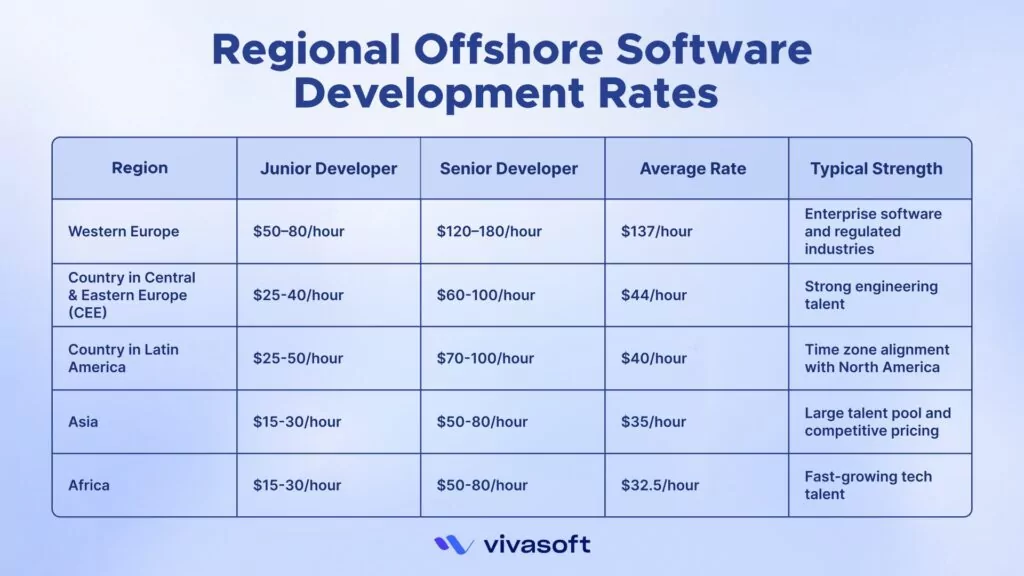
This cost guide will break down offshore software development rates by country and compare regional pricing. The image below provides a quick overview in this regard.
What Are Offshore Software Development Rates by Country in Western Europe?
Western Europe has the highest offshore development rates due to its experienced engineering talent and mature technology markets.
| Country | Average Rate | Junior Developers | Senior Developers |
|---|---|---|---|
| Germany | 79.56/hour | $50/hour | $150/hour |
| France | 65.50/hour | $50/hour | $150/hour |
| United Kingdom | 96.75/hour | $50/hour | $150/hour |
What Are Offshore Software Development Rates by Country in Central & Eastern Europe (CEE)?
Central and Eastern Europe offer competitive hourly rates with technical expertise. Here is an overview.
| Country | Average Rate | Junior Developers | Mid-Level Developers | Senior Developers |
|---|---|---|---|---|
| Poland | $40–$70/hour | $30-50/hour | $50-70/hour | $70-110/hour |
| Ukraine | $25–$55/hour | $25-40/hour | $40-60/hour | $60-100/hour |
| Romania | $30–$60/hour | $25-45/hour | $45-65/hour | $65-95/hour |
| Bulgaria | $30–$60/hour | $20-40/hour | $40-60/hour | $60-90/hour |
| Czech Republic | $35 - $70/hour | $35-55/hour | $55-75/hour | $75-120/hour |
| Serbia | $25-$49/hour | $20-35/hour | $35-55/hour | $55-85/hour |
| Hungary | $41-60/hour | $30-50/hour | $50-70/hour | $70-110/hour |
| Slovakia | $25-$65/hour | $30-50/hour | $50-70/hour | $70-110/hour |
| Croatia | $30-55/hour | $25-45/hour | $45-65/hour | $65-100/hour |
What Are Offshore Software Development Rates by Country in Latin America? (LATAM)
Latin America offers competitive developer rates with a convenient time zone overlap. It makes LATAM a popular outsourcing destination for North American businesses.
| Country | Average Rate | Junior Developers | Mid-Level Developers | Senior Developers |
|---|---|---|---|---|
| Mexico | $30–$50/hour | $25-50/hour | $50-70/hour | $70-100/hour |
| Brazil | $40–$60/hour | $25-45/hour | $45-65/hour | $65-90/hour |
| Argentina | $35–$55/hour | $20-40/hour | $40-60/hour | $60-85/hour |
| Colombia | $25–$45/hour | $20-40/hour | $40-60/hour | $60-85/hour |
| Chile | $40–$60/hour | $25-45/hour | $45-65/hour | $65-95/hour |
| Peru | $25-40/ hour | $25–$45/hour | $35–$60/hour | $37–$62/hour |
What Are Offshore Software Development Rates by Country in Asia?
Asia offers a large talent pool and some of the world’s most competitive developer rates. That’s why it remains the most popular offshore software development region for businesses.
| Country | Average Rate | Junior Developers | Mid-Level Developers | Senior Developers |
|---|---|---|---|---|
| India | $18–$40/hour | $15-30/hour | $30-50/hour | $50-80/hour |
| Vietnam | $20–$40/hour | $10-25/hour | $25-40/hour | $40-70/hour |
| Philippines | $18–$35/hour | $10-20/hour | $20-35/hour | $35-60/hour |
| Bangladesh | $18–$30/hour | $10-20/hour | $20-35/hour | $35-60/hour |
| Pakistan | $12 - $30/hour | $10-25/hour | $25-40/hour | $40-70/hour |
| Indonesia | $1-40 /hour | $12-25/hour | $25-40/hour | $40-65/hour |
| Malaysia | $25–$45/hour | $15-30/hour | $30-50/hour | $50-80/hour |
| Sri Lanka | $20 – $45/hour | $12-25/hour | $25-40/hour | $40-65/hour |
What Are Offshore Software Development Rates by Country in Africa?
Africa is expanding with tech communities and competitive pricing, gaining recognition as a cost-effective destination for offshore software development.
| Country | Average Rate | Junior Developers | Mid-Level Developers | Senior Developers |
|---|---|---|---|---|
| Egypt | $15-$35/hour | $15-30/hour | $30-50/hour | $50-80/hour |
| Nigeria | $15-$35/hour | $10-25/hour | $25-40/hour | $40-65/hour |
| Kenya | $15-$35/hour | $12-25/hour | $25-40/hour | $40-70/hour |
| South Africa | $20-$45/hour | $20-40/hour | $40-60/hour | $60-100/hour |
Offshore Developer Rates by Role and Technology Stack in 2026
Software developers’ roles and the technology stack they specialize in highly impact the offshore software development rates. For example, general software development skills are more affordable. In contrast, expertise in AI, cloud engineering, cybersecurity, and blockchain demands higher rates. That’s because developer rates are typically influenced by,
- The developer’s role and level of expertise
- Programming languages, frameworks, and tools used
- Experience with specialised or fast-growing technologies
- Project complexity and business requirements
- Regional talent availability and market demand
Cost Breakdown by Developer Role
| Developer Role | Hourly Rate (Global Avg) | Monthly Cost (Approx) |
|---|---|---|
| Frontend & mobile Developer | $30–$110/hour | $4,800–$17,60 |
| Backend Engineer | $35–$120/hour | $5,600–$19,200 |
| AI / ML / Data Analyst | $40–$85/hour | $6,400–$13,600 |
| DevOps & Cloud Engineer | $40–$130/hour | $6,400–$20,800 |
| Blockchain & Web3 Developer | $50–$150/hour | $8,000–$24,000 |
| QA engineers and manual testers | $25–$80/hour | $4,000–$12,800 |
| UX/UI designers | $25–$90/hour | $4,000–$14,400 |
Cost Breakdown by Technology Stack
| Primary technology stack | Senior developer rate | Mid-level developer rate |
|---|---|---|
| AI Infrastructure & MLOps | $100–$200+/hour | $35–$100/hour |
| Blockchain & Web3 | $100–$180/hour | $30–$100/hour |
| Cloud Infrastructure & DevOps | $90–$170/hour | $30–$90/hour |
| Next.js & TypeScript | $75–$130/hour | $45–$75/hour |
| Enterprise Backend Frameworks | $70–$125/hour | $40–$70/hour |
| Mobile Native & Cross-Platform | $65–$130/hour | $35–$65/hour |
| MERN / MEAN Stack | $55–$100/hour | $30–$55/hour |
| LAMP / Legacy-Adjacent Stack | $45–$85/hour | $25–$45/hour |
What Factors Affect Offshore Software Development Rates?
Along with the geographic location, the size of your project, the skills you need, and the way you hire your team can have an impact on the total cost. Check out the offshore software development rate affecting factors.
Country and City Within a Region
The country you outsource to has the biggest impact because labour costs and the local talent market vary significantly. For example, hiring a developer in Eastern Europe or Latin America can offer a 30–60% cheaper rate than US rates. The city also matters as much within each country. Like a Bangalore developer commands higher rates than in Jaipur, India,
Developer Seniority and Experience
Given the developer’s experience level, the hourly rates become high or low. Junior developers are a good fit for routine tasks, and mid-level developers can handle more complex work with less supervision. Senior developers cost more because they take ownership of technical decisions and solve complex challenges.
Engagement Model
Your pricing model can change the total project cost even with the same hourly rate.
| Engagement Models | Cost Predictability | Best for |
|---|---|---|
| Fixed-price | High | Small well-defined projects |
| Time and materials | Low | Agile and fast-changing products |
| Dedicated development team | Medium | Long-term product development |
| Staff augmentation | Medium | Skill gaps short team |
| Managed services | High | Maintenance support operations |
| Hybrid engagement model | Medium-high | Large enterprises |
Project Complexity and Scope
The complexity of your project directly affects development costs. A simple website or internal business tool costs less than software with AI features or strict security requirements.
Industry-Specific Expertise
Developers with experience in industries such as healthcare, fintech, banking, or insurance often charge higher rates because they understand sector-specific requirements. However, industry-specific expertise can reduce development time and lower compliance risks.
Vendor Type: Freelancer vs. Agency vs. Dedicated Team Provider
Freelancers usually charge the lowest rates but may have limited capacity for large/long-term projects. Software agencies cost more as they provide full project management and quality assurance. As for dedicated team providers, they are often the best fit for ongoing product development.
Market Demand Trends and AI’s Impact on Rates in 2026
Demand for offshore developers remains strong in 2026, with AI skills having increased 597% over the past five years. In contrast, traditional developer demand grew by 28% only. As a result, standard development has stable rates, while developers with proven AI charge significantly higher rates.
Hidden Costs of Offshore Software Development That Can Blow Your Budget
Many offshore projects exceed their initial budgets as indirect costs are often overlooked during planning. Here are those factors.
- Onboarding and knowledge transfer time
- Project management and communication overhead
- Developer attrition and turnover costs
- IT infrastructure and tooling expenses
- Training and upskilling costs
- Compliance and legal expenses
- Contract lock-ins and scope-change fees
- Rework costs from poor quality
- Travel costs for site visits and relationship management
How Do You Choose the Best Country for Offshore Software Development?
Businesses need to follow a structured evaluation process to reduce risk and get better value from their investment.
Step 1: Define Your Project Requirements, Tech Stack, and Timeline
First, define what you actually need to build. For example, if your project requires AI engineers or SAP specialists, a country with a large pool of experienced developers may provide better value than simply choosing the lowest hourly rate.
Step 2: Set a Realistic Budget
You should set a realistic budget, not just based on hourly rates. You can estimate the total project cost using the following formula.
Quoted Rate × 1.4 to 1.6 = True Loaded Cost
For example, if a vendor quotes $50,000, you should realistically plan for a total budget of around $70,000–$80,000.
Step 3: Prioritize Your Non-Negotiables
Identify the factors your project can’t compromise. It may include time zone overlap, English communication skills, data security, regulatory compliance, and experience with your technology stack.
Step 4: Shortlist Regions Based on Priorities
Next, compare your shortlisted regions based on hourly rates, technical expertise, communication, and time zone compatibility rather than price alone.
| Region | Typical Average Rate (USD/hour) | Why Choose This Region | Ideal For |
|---|---|---|---|
| Western Europe | $137/hour | Excellent technical expertise and a mature software industry | Enterprise systems and large-scale digital transformation projects |
| Central & Eastern Europe | $44/hour | High-quality engineering talent with lower rates | SaaS products and long-term software development |
| Latin America | $40/hour | Close working hours for North American businesses | US and Canadian companies requiring real-time collaboration |
| Asia | $35/hour | The largest software talent pools with highly competitive pricing | Startups, SMEs, AI, cloud, web, and mobile development |
| Africa | $32.5/hour | Rapidly expanding developer communities with competitive pricing | Startups and digital products |
Step 5: Evaluate Vendors
After selecting a region, compare software development companies. Review independent ratings of the providers on Clutch or GoodFirms, and examine recent case studies. You should also request relevant code samples and verify experience with projects similar to yours.
Step 6: Assess Cultural Fit and Communication Quality Before Signing
Schedule discovery calls with your shortlisted vendors before signing a contract. Evaluate their communication skill, respond to feedback, ask technical questions, and explain project risks.
Step 7: Start With a Paid Discovery or Pilot Project Before Full Commitment
Instead of committing to a long-term engagement immediately, begin with a small paid project or discovery phase. It allows you to evaluate technical capability, delivery speed, collaboration, and code quality before investing in a larger software development project.
Step 8: Negotiate IP Assignment, Contract Termination, and Data Protection Clauses
Lastly, confirm who owns the intellectual property and how confidential data will be handled. The contract should also define payment terms, scope change procedures, and post-project support to avoid disputes later.
Which Country Offers Affordable Offshore Software Development with High Technical Proficiency?
Several countries offer a strong balance between affordable development costs and technical expertise. Based on the comparisons above, India, Vietnam, Bangladesh, Poland, and Ukraine are among the most attractive destinations for offshore software development.
India is a reliable all-round option, with a large talent pool and expertise across a wide range of technologies. Vietnam and Bangladesh are particularly appealing for businesses looking to keep development costs competitive without compromising on quality. If Bangladesh is one of the destinations you’re considering, you can explore our guide to the top software companies in Bangladesh to compare potential development partners and find a team that fits your project requirements.
Poland and Ukraine, on the other hand, are often better suited to complex or enterprise-level projects that require experienced engineering teams and advanced technical expertise.
Ultimately, the best offshore development destination depends on your budget, required skill set, project complexity, communication needs, and preferred time-zone overlap.
Why Choose Vivasoft as Your Offshore Software Development Partner?
Vivasoft offers a practical combination of technical expertise, flexible hiring models, and cost efficiency for global businesses. Companies can hire dedicated offshore developers for software development projects and work with experienced engineers skilled in modern technologies to extend their teams. Moreover, Vivasoft has worked with clients in the US, Europe, and Australia, making it a reliable option for organizations that want to scale their development capabilities without building an in-house team.
FAQs about Offshore Software Development Rates
How often do offshore software development rates change?
Offshore software development rates generally adjust once or twice a year. It generally follows annual inflation, localized currency fluctuations, and shifts in regional tech demand. However, the effective cost frequently changes based on seniority and project scope.
Are offshore software development rates negotiable?
Yes. Offshore software development rates are highly negotiable. Depending on the engagement, you may be able to secure discounts by committing to longer contracts or hiring more developers.
Does a lower hourly rate always mean lower total development costs?
Not essentially. Less experienced developers often take significantly longer to complete tasks and produce code that requires expensive rework. It offsets the savings from the lower per-hour price.
What Is the Difference Between Offshore, Nearshore, and Onshore Development?
Onshore means working with a local team in your own country. Nearshore involves outsourcing to a neighboring or nearby country with a minimal time difference. In contrast, offshore means hiring a team in a distant country, often on a different continent.
Are Offshore Developers as Good as Local Developers?
Yes, offshore developers are technically skilled as local ones, but they operate differently. You can hire 2 to 3 senior offshore developers for the price of one local developer, making them ideal for budget efficiency. However, local hires provide immediate communication and a deep understanding of your target market.