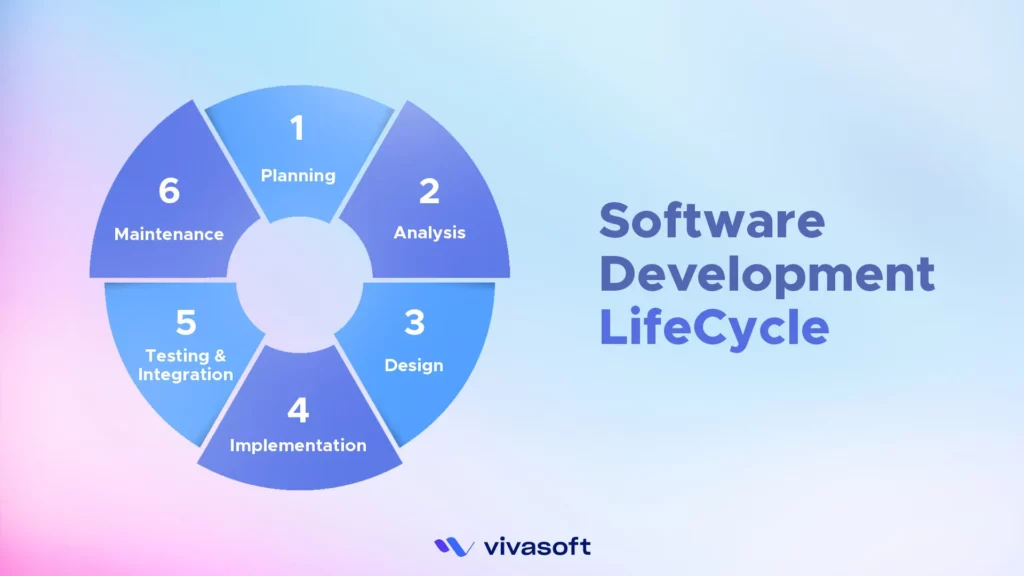
Software development isn’t just coding. Instead, it demands precision. Consider the initial step: gathering clear requirements. From that point, design naturally follows. Soon after, testing verifies that the solution meets expectations. When all aligns, deployment delivers the product. Overlooking any part invites setbacks, deadlines falter, budgets strain, quality suffers.
Turning attention now to the Software Development Life Cycle, or SDLC. This framework segments work into defined stages. Such division helps teams maintain focus, control over scope becomes easier. Also, quality remains consistent throughout. In addition, technical work stays aligned with business goals. Without this structure, disorder tends to creep in.
What is the Software Development Life Cycle (SDLC)?
The Software Development Life Cycle, or SDLC, is the formal, disciplined process we use to build software from idea to deployment and beyond. It’s not just “steps.” It’s not a diagram to memorize for exams. It is the answer to this question: “How do professionals ensure that software is purposeful, reliable, maintainable, and delivered on time?” The SDLC is how we bring order to creativity, and that’s the essence.
Importance of Software Development Life Cycle
Without a strict process, software projects spiral into chaos. SDLC imposes rigor that turns complexity into manageable, accountable work.
- Problem Detection Becomes Predictable: Because SDLC starts with requirement analysis, you find logical flaws before any code is written.
- Developers and Clients Stay Aligned: Requirement documents and review sessions ensure both sides are literally on the same page.
- No Wasted Time or Budget Drift: Planning and estimation are done upfront, so teams don’t “keep building blindly.”
- Reduces Emergency Fixes After Launch: Validation and verification are done methodically, minimizing last-minute surprises.
- Every Team Member Knows Their Scope: Roles and tasks are assigned by phase, reducing confusion and overlap in responsibilities.
Components of the Software Development Life Cycle
The SDLC organizes software work into clear, manageable chunks to avoid chaos. Each part tackles specific challenges to steadily build a robust system.
- Requirements: This phase forces precision about what the software must do, vague ideas won’t cut it. If this step fails, the whole project drifts off course.
- Design: Design draws the roadmap for the system’s structure and data flow. Without it, coding becomes guesswork and errors multiply.
- Implementation: Here, code is written following strict rules laid out in the design. Sloppy coding here creates headaches that ripple through the project.
- Testing: Testing is the relentless hunt for bugs and flaws before users find them. It’s the final filter that protects the product’s quality.
- Deployment: Deployment moves the software into real use, where unexpected problems often appear. Preparing rollback plans isn’t optional, it’s survival.
- Maintenance: Maintenance keeps the software alive, fixing issues and adapting to change. Every tweak must be cautious to avoid breaking what already works.
Each phase depends on the last; if something’s wrong early, it poisons everything after. Strong links and clear communication between stages stop small mistakes from exploding. Moreover, documentation is not optional, it’s the project’s memory. Without it, fixing, updating, or understanding the system becomes guesswork and risk.
Phases of the Software Development Life Cycle
The SDLC typically includes the following seven core phases:
- Requirement Gathering and Analysis
- Feasibility Study
- System Design
- Implementation (Coding)
- Testing
- Deployment
- Maintenance
Each phase is important to make sure the software works properly and does what the users need, while also following the technical requirements.
1. Requirement Gathering and Analysis
This phase involves identifying observable, testable, and traceable behaviors the system must support not just features, but underlying rules, constraints, and edge cases. The value here lies in separating what users say from what they actually need, and documenting that in a structured form that doesn’t collapse under interpretation.
2. Feasibility Study
A feasibility check breaks the idea into technical operations, time complexity, cost boundaries, hardware demands, and operational logistics, each is evaluated with a hard yes or no. This phase isn’t a casual discussion; it’s a diagnostic layer that protects against blind execution of infeasible expectations.
3. System Design
Design is about establishing formal structure: module boundaries, data flow direction, control hierarchy, memory and process allocation, and interface behavior- all mapped before any implementation begins. The objective is to ensure every component’s input/output, state transitions, and dependencies are defined in a way that can be coded without guessing.
4. Implementation (Coding)
Implementation is not just writing code, it’s about writing code that aligns exactly with defined logic paths, respects data contracts, follows scope boundaries, and holds up under modular interaction. Each class, function, or method must reflect not only syntax correctness but also architectural intention.
5. Testing
Testing involves constructing input cases that probe the system’s reaction at both expected and non-deterministic boundaries covering unit behavior, inter-module data flow, and environment dependencies. It’s a deliberate attempt to invalidate the system’s assumptions and detect the earliest failure conditions possible.
6. Deployment
Deployment prepares the system to operate in its final runtime conditions, including handling real data streams, executing on production infrastructure, and integrating with external services or APIs under controlled version states. It must account for rollback triggers, load distribution, error logging, and runtime observability from day one.
7. Maintenance
Maintenance includes live patching, adaptive tuning, backward-compatible feature updates, and architectural refactoring when necessary often under operational pressure. The phase requires an ongoing audit of system health, behavior patterns, and silent failures that only emerge with prolonged use.
Software Development Life Cycle Models

SDLC models are frameworks to structure software development efficiently. They help us control complexity and ensure delivery quality.
- Waterfall Model: Waterfall demands finishing one phase before starting the next. It’s only reliable when requirements won’t change midstream.
- V-Model: The V-Model matches each development step with a testing step to catch issues early. It’s highly disciplined and suits projects with zero tolerance for defects.
- Iterative Model: This model works in cycles, letting you revisit and improve features regularly. It’s practical when requirements aren’t fully defined upfront.
- Spiral Model: Spiral emphasizes constant risk evaluation through repeated loops. It’s designed for complex projects where uncertainty is high.
- Agile Model: Agile uses short sprints and constant feedback to stay flexible. There are some key differences between SDLC framework and agile development. Agile model is the go-to when speed and adaptability are priorities.
Agile vs Traditional Models:
| Aspect | Agile | Traditional |
|---|---|---|
| Flexibility | Responds quickly to change | Sticks to fixed plans |
| Speed | Delivers incrementally | Follows sequential steps |
| Risk Handling | Managed continuously | Assessed before start |
| Use Case | Ideal for evolving needs | Suited for stable scope |
Software Development Life Cycle Flowchart and Diagram
The software development life cycle isn’t just a sequence; it’s a system. The flowchart and diagram show how each phase connects, step by step, turning complexity into clarity.
Flowchart:
Start
↓
Requirement Analysis
↓
System Design
↓
Implementation (Coding)
↓
Testing
↓
Deployment
↓
Maintenance
↓
End
This flow shows how one phase naturally leads to the next. But in real-world cases, it’s not always linear. Rather, sometimes we jump back and forth when changes are needed.
Here’s the visual diagram of the SDLC:
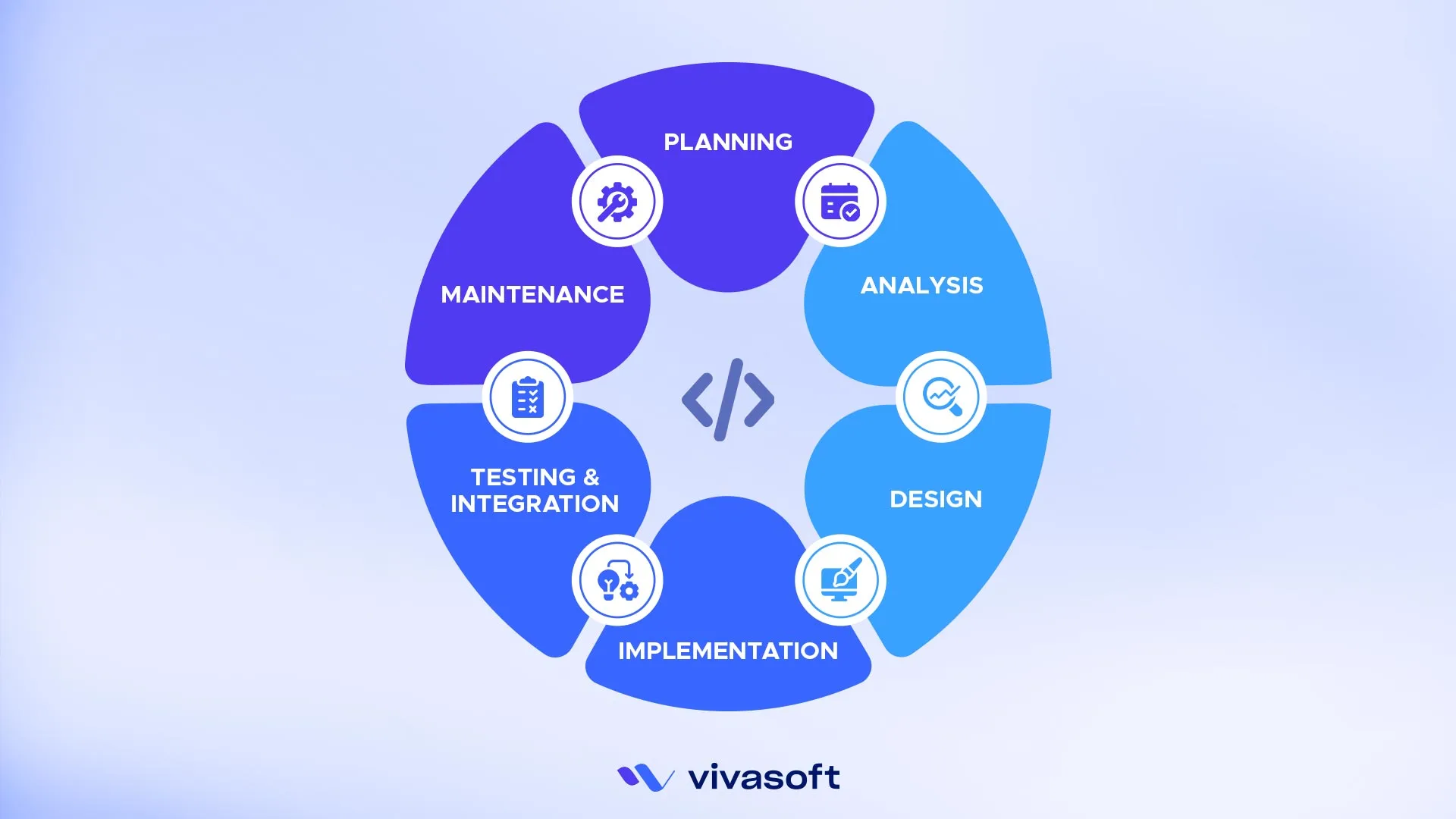
The main stages of software development are outlined in the SDLC diagram: planning, analysis, design, implementation, testing, integration, and maintenance. The phases make sense as they go, and monitoring maintenance informs future planning cycles to guarantee methodical development and iterative improvement.
Tech Stack for Software Development Life Cycle
The tech stack is not just a checklist. Instead it’s the architecture that dictates your project’s trajectory. Every component must align precisely with your goals and constraints.
- Languages (Java, Python, or JavaScript): Languages are the very syntax your ideas are built on, nothing more, nothing less. Pick the one your team can wield effectively without fumbling.
- Frameworks (React or Django): Frameworks are your project’s rulebook, guiding consistent and efficient coding. They’re indispensable when you need order in complexity.
- Databases (PostgreSQL, MongoDB): A database isn’t just storage, it’s the foundation for your data’s speed and integrity. Choose carefully, because it determines your app’s responsiveness under pressure.
- Servers and Runtimes (Nginx, Node.js): Servers and runtimes deliver your software to users; they must never be a bottleneck. Stability under stress is non-negotiable in production.
Each tool plays a part and they all need to work together. But how do you choose the right stack? You don’t pick based on hype. You pick based on fit. Ask these three questions:
- What does the project need? A large-scale product needs a stack built for scale.
- Will it scale over time? Your stack should handle growth not just now, but a year from now.
- What’s your team good at? The best tools are the ones your team can use confidently.
Software Development Life Cycle Tools
These tools are the framework holding the entire software process together. Without them, managing complexity is near impossible and errors skyrocket.
- Project Management Tools: Jira and Trello organize tasks, timelines, and responsibilities with precision. They prevent confusion and keep everyone accountable.
- Version Control Tools: Git and GitHub track every change in the code so no one overwrites another’s work. This is non-negotiable in any professional environment.
- Testing Tools: Selenium and JUnit automate bug detection before the software hits production. Early detection means less rework and higher quality.
- CI/CD Tools: Jenkins and CircleCI automate the tedious build and deploy steps. This reduces errors and speeds up how quickly you get features live.
In professional software development, these tools aren’t extras; they’re essentials. Using them rigorously is what separates successful projects from failures.
Types of Software Development Life Cycle
SDLC types are different frameworks to manage how software is built based on project demands. The choice depends on how fixed or flexible the requirements are, and the scale of the project.
- Predictive SDLC: This is highly structured and follows a fixed sequence of phases — from planning to deployment. It works best when requirements are well-defined from the beginning. A classic example is the Waterfall model.
- Adaptive SDLC: It is more flexible. Here, requirements can evolve over time, and development happens in short cycles. Agile is a prime example — ideal for fast-moving or uncertain projects.
- Hybrid Approaches: A blend of both. It combines the upfront planning of predictive models with the iterative flexibility of adaptive methods. Many teams use this to balance control with adaptability.
Example of Software Development Life Cycle
The Hink project focused on building a platform for location-based action photo sharing with donation features. It required careful coordination of multiple technologies and clear milestones.
Walkthrough:
- Planning: We identified core requirements: geotagged photo sharing, donation integration, and high availability. The team outlined scope, risks, and timelines to set a clear roadmap.
- Design: UI/UX crafted interfaces for photo discovery and donations. System architects designed the backend to integrate Google Maps API, AWS, and Stripe smoothly.
- Development: Developers implemented features using Golang, React, Flutter, and cloud services. Emphasis was placed on concurrency and performance, such as multipart uploads to AWS S3.
- Testing: QA conducted functional and performance tests, ensuring uploads, payments, and map features worked flawlessly. Automated and manual tests caught critical bugs early.
- Deployment: The product was launched using Kubernetes for stability and scalability. Ongoing monitoring ensured quick responses to issues.
Outcome: The SDLC approach delivered a 40% increase in user engagement and halved page load times, directly benefiting from disciplined planning and testing. Streamlined admin tasks and reliable donation flows demonstrated how rigorous development improves both user and business outcomes. The project underscored the importance of integrating diverse technologies cohesively under a solid process.
Domains Where SDLC Is Applied
SDLC is the framework that guarantees discipline and quality in software projects. Without it, chaos and failure are almost certain.
- Web Application Development: Web apps must handle traffic securely and efficiently. SDLC ensures these systems are built with reliability and scalability in mind.
- Mobile Software Development: Mobile apps must work flawlessly on numerous devices. SDLC manages this complexity to deliver consistent performance.
- Desktop Software Development: Desktop software requires stability across various hardware and OS. SDLC enforces rigorous development and testing.
- Enterprise Software: Enterprise software integrates core business functions securely. SDLC guarantees proper architecture and data integrity.
- Embedded Systems & IoT: Embedded software runs on limited resources with strict timing. SDLC mandates precision and exhaustive validation.
- Gaming Industry: Games demand high frame rates and immersive experiences. SDLC organizes complex workflows to meet these expectations.
- Cloud Computing & SaaS: Cloud systems must scale elastically and maintain uptime. SDLC structures development to ensure robustness and flexibility.
- Banking & Finance: Financial software cannot compromise on security or compliance. SDLC embeds these principles at every stage.
- Healthcare & Medical Software: Healthcare software safeguards sensitive data and critical processes. SDLC ensures patient safety and regulatory compliance.
- Telecommunications: Telecom systems require uninterrupted service and low latency. SDLC enforces processes to meet these demanding goals.
- Government & Defense: Government software demands transparency and security by mandate. SDLC guarantees adherence to strict standards.
- Education & E-learning: Educational software must be accessible and dependable. SDLC ensures stability and ongoing support.
Where the Software Development Life Cycle Is Applied
SDLC is used wherever software development must be disciplined and reliable. It prevents chaos and ensures projects deliver as promised.
- Finance: Financial systems handle sensitive data and complex transactions. SDLC makes sure they’re secure and compliant with regulations.
- Healthcare: Healthcare software must be precise and protect patient privacy. SDLC enforces these critical requirements without compromise.
- Retail and E-commerce: Retail platforms need to manage inventory and sales without fail. SDLC keeps the software stable and responsive.
- Education: Educational software supports learning and assessment tools. SDLC ensures these systems work effectively over time.
- Telecommunications: Communication networks cannot tolerate failures. SDLC guarantees resilience and continuous operation.
- Manufacturing: Precision and safety are paramount in production software. SDLC maintains strict quality from design to deployment.
- Government and Public Sector: Public software requires transparency and security. SDLC enforces standards to maintain trust and compliance.
- Logistics and Supply Chain: Tracking and delivery systems demand accuracy and speed. SDLC minimizes errors and streamlines processes.
- Real Estate: Real estate software manages complex property data. SDLC ensures dependable and secure operation.
- Travel and Hospitality: Booking and service platforms must be reliable and user-friendly. SDLC structures development to meet these needs.
- Media and Entertainment: Media platforms handle large content volumes and traffic spikes. SDLC ensures performance and uptime.
- Legal and Compliance: Legal software requires accuracy and audit trails. SDLC guarantees compliance and data integrity.
- Energy and Utilities: Energy systems monitor distribution and demand in real time. SDLC enforces thorough testing and safety.
- Agriculture and Agritech: Farm tech software needs to scale and adapt reliably. SDLC structures development for sustainable growth.
- Non-profit and NGOs: Software must track donations and impact accurately. SDLC guarantees accountability and transparency throughout development.
AI in Software Development Life Cycle
We should think of AI in the SDLC as an extra-sharp assistant. It helps write code, spots bugs before you do, and even predicts problems in design or maintenance. Used properly, it saves time and saves you from some very expensive mistakes.
- Automated Code Generation and Review: AI can draft chunks of code for you and point out mistakes or weak spots before they become real problems. It’s like having a teaching assistant who never sleeps.
- Predictive Analytics for Project Management: It looks at your past projects, spots patterns, and tells you where delays or issues are likely to happen. That means fewer surprises and fewer late nights.
- Intelligent Testing Tools: AI can run tests, find odd bugs you didn’t think of, and even adjust the tests as your software changes. It’s faster, sharper, and far less forgetful than we are.
AI in the SDLC cuts down human error and enforces discipline. It spots problems before they become crises and helps you manage complexity with data, not guesses. That’s how you keep projects on track and maintain the high standards real professionals demand.
Advantages of Software Development Life Cycle
SDLC creates a strong framework that guides every step in building software. It improves quality and helps use resources carefully.
- Predictability: Breaking work into clear stages helps you plan time and cost more accurately.
- Customer Satisfaction: Regular milestones and deliverables keep clients informed and confident.
- Risk Reduction: Finding problems early through planning and testing lowers the chance of costly failures.
- Team Coordination: Clearly defined roles and steps help the team work smoothly together.
Disadvantages of Software Development Life Cycle
If the project goals keep shifting or aren’t clear, the work gets stuck and deadlines slip.
- Rigidity in traditional models: When the plan is fixed early, changing it later is hard and slows the team down.
- Time-consuming planning and documentation: Writing detailed documents takes time before coding starts, which can delay the project.
- Resistance to change: People find it difficult to change requirements once set, making updates tough.
Software Development Life Cycle Best Practices
When you follow these best practices, your SDLC becomes predictable, your risks go down, and your final product aligns better with user needs. A good process doesn’t slow down creativity; it protects it.
- Clear and thorough requirements gathering: Meet with users and write down exactly what they want. Confirm every detail before coding starts.
- Regular communication and feedback loops: Hold frequent meetings. Share updates and fix misunderstandings quickly.
- Incremental testing and quality assurance: Test small parts right after building them. Run tests often to find problems early.
- Using appropriate tools and automation: Use software to build, test, and deploy automatically. This reduces errors and saves time.
- Flexibility to adapt to changes: Design code in small pieces. Work in short cycles so you can make changes without breaking things.
Conclusion
Looking deeper, discipline is non-negotiable. Creativity alone doesn’t suffice. SDLC enforces rigor and guarantees no step is skipped. As a result, risks appear early, resources are used efficiently, and complexity becomes manageable. Moreover, it is the blueprint to reduce uncertainty. However, whether projects are small or vast, following SDLC increases success rates. The outcome is software that is reliable, efficient, and aligned with user needs. This structure supports professional development at every level.