MVP development for the healthcare industry requires expert-level precision and careful planning. You need to design it with only the core essentials that will solve real patient and clinician problems while keeping safety and compliance front and center. Almost 84% of healthcare organizations are adopting digital tools and telehealth today. Thus, there’s a big opportunity to make a meaningful impact.
To achieve this, you need to build an MVP that targets one clinical gap with sharp focus. Also, it should include strong security measures, proper data handling, and compliance with regulations from day one. In this guide, you will find the exact steps and technical details to develop a scalable and clinically grounded MVP.
What Is a Healthcare MVP?
A healthcare MVP is the simplest possible version of a new product or service that has a constrained feature set focused on one clinical objective. It is completely different from the standard MVPs. Here, you can expect strict validation steps aligned with clinical logic checks and risk-control measures.
Here is what more healthcare MVPs unique:
- The product can serve multiple users for different purposes. Such as patients, clinicians, administrators, and payors.
- It must integrate smoothly with hospital systems, including EHR/EMR.
- Even the “minimal” version must have strong security and compliance with HIPAA and GDPR. Healthcare facilities define how you store patient data and what logs you must keep.
However, it is not always mandatory to build an MVP for the healthcare industry. You can skip the process when the need for the feature directly affects patient diagnosis. Must skip it to generate prescriptions or urgent clinical actions.
Is an MVP the Right Approach for Your Healthcare Product?
Yes, it is safe and practical to create an MVP for the service with a lower clinical risk. For example, patient engagement tools, telehealth modules, or workforce automation. These areas have predictable and well-defined processes.
In case there are any errors or bugs, it usually doesn’t endanger a patient. In contrast, high-risk clinical products, such as diagnostic engines, ICU or operating room tools, and clinical decision support systems, can affect patient outcomes. The complete system requires full validation and a complete feature set for surgery rather than a simple version.
To determine if an MVP is appropriate, you need to clarify that the problem is clearly defined and possible to track or measure. Make sure all stakeholders will agree on what the MVP will do. It helps prevent misaligned expectations. Finally, ensure the product can comply with privacy regulations. Also, the data should be accessible from sources, such as EHRs or medical devices.
How Do You Build a Healthcare MVP?
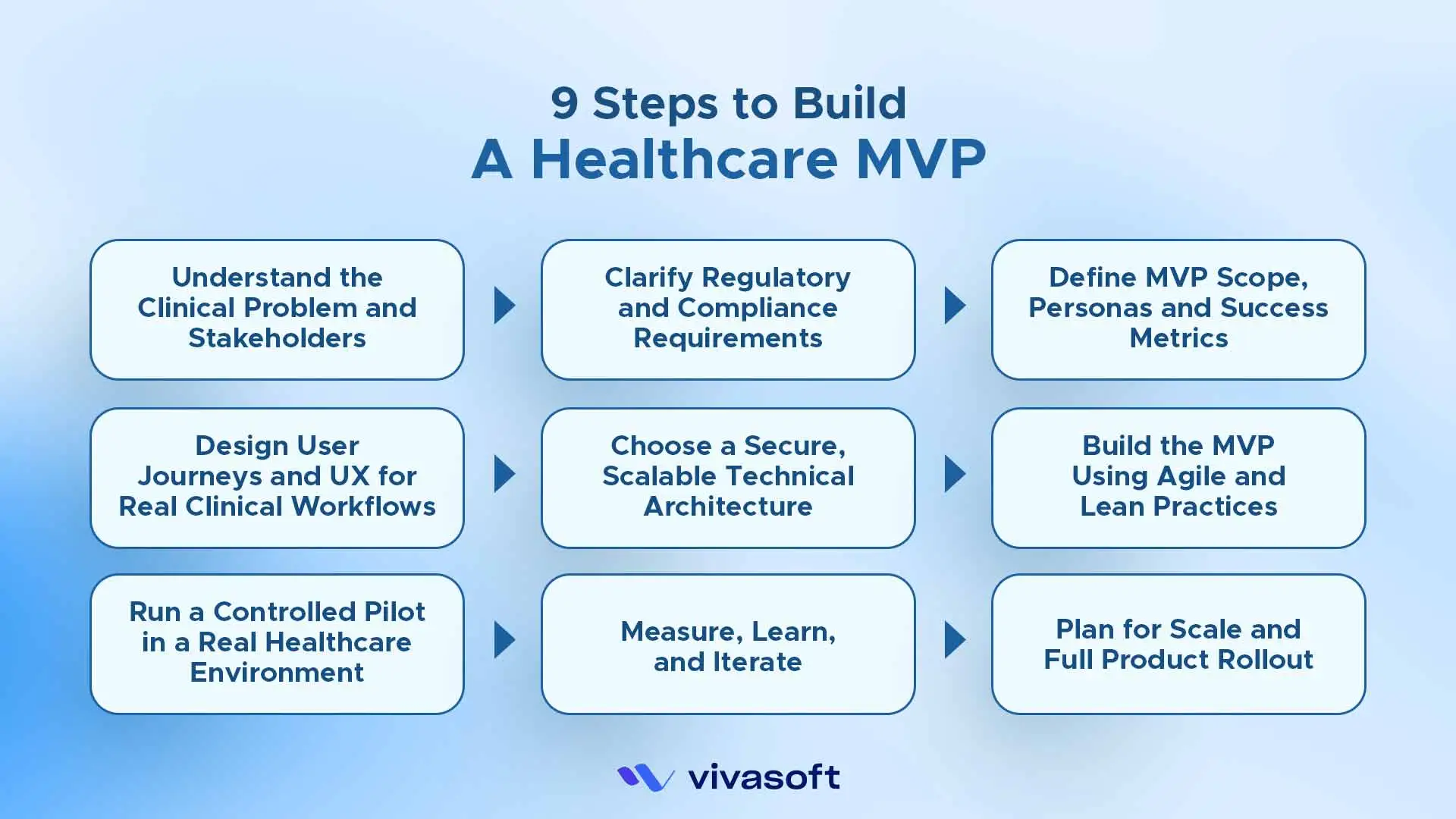
To build a healthcare MVP for any clinical workflow and patient journey, you must identify a specific problem and define core, compliant features. Then build a minimal prototype and test it with users for quick validation. Here are the 9 steps to build a healthcare MVP.
Step 1: Understand the Clinical Problem and Stakeholders
First, you have to clearly define the actual clinical problem. For this, you can assess the workflow directly and find out where clinicians face difficulties. Then track down the data flow in the healthcare process.
Specifically, through EHR screens, input devices, or handoff moments. Next, list stakeholders across patients, clinicians, admins, and payors, and their most faced challenges.
Step 2: Clarify Regulatory and Compliance Requirements
Now focus on the regulatory rules that will protect your health data. For this, identify the exact rules that apply to your data flows. You then need to define data management policies. Like storage, transmission, or retention policies.
Finally, plan for audit logs and security policies that will save sensitive data. The goal is to make your system’s design safe and legal. For example, a remote patient monitoring MVP needs BAAs, PHI-scoped tables, and explicit consent screens.
Step 3: Define MVP Scope, Personas, and Success Metrics
After setting compliance rules, now focus the MVP on the main clinical problem without trying to fix everything at once. For this, it would be better to write a clear problem statement where you will cleverly highlight the primary gap.
Next, create detailed personas for each user role and define their usability. Then choose only the essential features that solve the main problem. It would be issued in intake forms, task queues, or symptom logs. Besides, focus on how you measure success for each as well.
Step 4: Design User Journeys and UX for Real Clinical Workflows
When you are done with feature selection, map out user journeys in detail. For example, if it is a remote patient monitoring MVP, the user’s journey starts when they log into the system. The journey flows with checking the patient list, reviewing vitals, and responding to alerts. Next, build a wireframe focusing on rules.
Every UI element in the prototype must meet the high standards required for patient care. Healthcare systems often face technical issues, so plan ahead for handling errors. All in all, the design should fit all clinical environments.
Step 5: Choose a Secure, Scalable Technical Architecture
At this stage, design the backend architecture for your MVP. Start with a modular structure. Whether it would be a modular monolith or small microservices. Each module must define specific tasks, like authentication, clinical data, or billing.
Now select a cloud system that offers managed databases and secure storage. Also, you need standard APIs for your app’s core function and interfaces to interact with the hospital data. Then apply strict security controls. Such as encrypting data, using role-based access, and modern login standards. Finally, set up logs and dashboards to monitor system health and catch errors earlier.
Note: A modern, high-quality approach for a healthcare MVP is “Secure by Design” using DevSecOps. It defines that security isn’t just added at the end with firewalls. This makes it possible to integrate security at every phase of the software development lifecycle. It keeps the system safe from day one.
Step 6: Build the MVP Using Agile and Lean Practices
Focus on building the product in small, iterative cycles. For this, use short sprints that will deliver the functional pieces of the core workflow. The goal is to maximize validated learning by quickly turning requirements into demonstrable software.
So focus on features that directly solve the primary clinical problem. Of them, security and compliance must be a non-negotiable part of every feature from the outset. This would involve:
| Security Feature | Purpose |
|---|---|
| RBAC | Limits users' access so only a few selected ones can see or edit what they need. It keeps the data private. |
| Audit Logging | Keeps a record of who accessed or changed PHI, helping meet regulatory requirements. |
| Field-Level Validation | Ensures data is entered correctly, with the right format and values. |
| PHI-Safe Application Logging | Keeps sensitive patient information out of system logs to protect privacy. |
Step 7: Run a Controlled Pilot in a Real Healthcare Environment
After building the MVP, test it in a small and controlled clinical setting. Like you can start with a single unit or care team. This way, you can observe the real usage flows without risking the entire hospital. Specifically focus on how the data is moving through EHRs, devices, and screens.
Find and note the errors, if any. Observing clinicians under real pressure reveals real problems that lab tests often miss. Watch for problems that could affect patient safety while testing your MVP. It could be wrong entries or slow syncing.
Note: The Therac-25 radiation tragedy is a historical example of how managing patient data is important. Here, some unnoticed software bugs and incomplete hardware safety checks caused massive radiation overdoses. It resulted in multiple patient deaths and serious injuries.
Step 8: Measure, Learn, and Iterate
After the pilot, now analyze the data to see what works and what doesn’t. List down the features that are actually proven functional and which slow down workflows.
Check the logging and monitoring cycle to review what was entered. Improve frontend validation to prevent unsafe data from entering. Remove the low-value features and redesign the UI to use standardized input controls based on clinical vocabularies.
Step 9: Plan for Scale and Full Product Rollout
Now that your MVP has been tested and improved, plan to scale the system. It should handle more users and higher data volumes. Also, as needed, expand integrations with healthcare tools.
Test the system under peak usage time. It will help reveal its core usability. Above all, keep the security and compliance up-to-date. Also, create documentation for security reviews, vendors, and audits.
What Core Features Should Be Included in a Healthcare MVP While Avoiding Overbuilding?
A healthcare MVP should include only the essential features that improve clinical workflows efficiently. Such as:
Patient-Facing Features
Offer tools for the patients, like tracking symptoms or booking appointments. Ensure security is strong. For this, verify patient identity. Add effective forms that work safely on their devices and protect sessions. Overall, the interface should load without any interruption, even in low-bandwidth areas.
Clinician-Facing Features
Clinicians need easy-to-use tools such as structured charts, task lists, and clear overviews of orders or vital signs. The interface should efficiently identify errors and simplify routine tasks so they can be completed easily during busy shifts.
Admin & Back-Office Features
For the admission team, include some must-have tools, such as role management, dashboards, and so on. The system must automatically record everything important that happens. It would be event logs, imports, and exports of patient data.
Non-Negotiable Security & Compliance Features
Your app must encrypt all data for security. Use role-based access control to define who sees patient files. Implement audit logs and strict breach plans that will help protect from cyberattacks and comply with regulatory laws.
How Much Does It Cost to Build a Healthcare MVP?
The cost of building an MVP typically ranges between $150K–$400K. But the final pricing would vary based on notable factors. This includes:
- Workflow complexity
- Number of integrations
- Or, the security requirements.
Generally, simple apps with minimal features cost less. Whereas AI-powered or fully integrated systems cost more.
What Are the Typical Cost Ranges for Different Types of MVPs?
The table below shows typical ranges for common MVP types.
| MVP Type | Cost Range |
|---|---|
| Scheduling App | $15,000 – $40,000 |
| Telehealth MVP | $40,000 – $120,000 |
| Workflow Tool | $30,000 – $80,000 |
| EHR Module | $80,000 – $250,000+ |
| AI/ML-Powered Tool | $100,000 – $300,000+ |
What Are Practical Ways to Reduce Costs Without Compromising Safety?
To reduce the cost, consider the following practices:
- Work on the core features and avoid overloading the MVP.
- Use the existing platforms and APIs.
- Start with one platform and then build for another.
- Utilize open-source frameworks. It ensures the best compliance and security as with saving cost.
- Pilot your MVP in a limited real-world scenario before deploying the full product.
- Outsource your MVP development project instead of doing it in-house to save costs and ensure expertise.
What Mistakes Should Be Avoided When Building a Healthcare MVP?
These are some of the most commonly reported mistakes that teams make when developing healthcare MVPs:
Overloading the MVP With Features
If you overload the MVP with unnecessary features, it makes the product complicated and hard to build. Even if it becomes slower for users to adopt. As a solution, focus on only the core clinical problem. The best tip is to start with essential features that prove your main idea works.
Ignoring Clinical Workflow Reality
When you design an MVP without understanding how clinicians actually work, it makes the process inefficient or even unsafe. It mostly reduces the adoption rate. To prevent this, focus on clinicians in real settings and map the actual workflows.
Underestimating Compliance and Legal Complexity
If you fail to make MVP compliant with HIPAA, GDPR, or local regulations, expect fines and delayed deployment. To ignore the hurdle, ensure defining data handling policies and retention rules starting development.
Weak Security Practices
Without proper security measures implementation, patient information could be leaked. Even such a small mistake can lead to regulatory fines or legal trouble. Embed the strong security from day one.
Poor UX Leading to Low Adoption
If the interface is confusing, clinicians or patients may stop using it, and you won’t get real feedback. Use simple, structured inputs with clear workflows in the MVP UI.
No Clear Success Metrics or Experiment Design
If you want to track the success of MVP at every stage, it is impossible to know whether the MVP solves the clinical problem. To prevent this, set clear, measurable metrics from the first. Design pilots to collect data and iterate based on real evidence.
Top Trending Healthcare MVPs (Real Success Stories)
Have a quick glimpse of the real-world health care MVPs that are dominating the industry with some superior functionalities:
Heidi Health
Heidi Health is a well-known AI‑powered medical‑scribe tool specifically designed to transcribe consultations and convert them into structured clinical notes. It was introduced to reduce the documentation burden. It also improved workflow efficiency. By 2025, Heidi reports over two million patient interactions per week using their platform.
Counterforce Health
Counterforce Health is another AI-powered software that helps patients and clinics with insurance claims and billing. The software automates parts of the appeals process for denied claims. It makes it easier and faster to challenge denials. Even if it was launched in 2025, the software had notable early adopters with the highest satisfaction rate.
Cedars‑Sinai + K Health
Cedars‑Sinai + K Health has developed a telehealth and virtual care platform called CS Connect. This AI-powered platform is designed to handle patient queries 24/7, check symptoms, and offer preliminary treatment suggestions.
Even the doctors review and confirm the AI’s recommendations. By 2025, over 42,000 patients had used the platform. Even the report says that about 77% of AI treatment suggestions generated from the platform were rated optimal.
How Do You Choose the Right Partner to Build Your Healthcare MVP?
Choosing the right development partner is essential to building a secure, compliant, and high-performing healthcare MVP. Look for senior engineers with hands-on experience in healthcare standards, clinical workflows, and interoperability. This ensures your MVP is built with the level of precision and reliability that teams like VivaSoft consistently deliver.
Before reaching out to potential development companies, take time to understand your project’s scope, budget, and priority features. Select a partner with a strong tech stack, agile development practices, and, before committing, use our free MVP cost calculator to estimate costs and refine your requirements. With this clarity, you can confidently choose a team capable of integrating complex systems and managing large volumes of clinical data.