
Case Study
Automating 10M Monthly Invoices for Malaysia’s Leading Telecom

 Industry
- Telecommunication services and Internet technology services
 Region
 Overview
Our client, the leading telecom company of Malaysia, delivers comprehensive connectivity solutions across both prepaid and postpaid segments. It historically holds a strong market share across mobile, broadband, corporate, and SME business lines. The Company operates in three segments: mobile services, fixed line services, and international gateway services. According to the company itself, its network coverage reaches over 93% of Malaysia’s population, making it one of the country’s largest converged-network providers.
To support the growth of the digital economy, the Government intends to implement e-Invoice in stages in an effort to enhance the efficiency of Malaysia’s tax administration management (LHDN/IRBM). The e-Invoice will enable near real-time validation and storage of transactions, catering to Business-to-Business (B2B), Business-to-Consumer (B2C), and Business-to-Government (B2G) transactions. Consequently, Vivasoft Limited engineered an e-Invoice processing engine/platform for the telecom provider that automates the generation and validation of transaction documents and orchestrates the electronic transmission of structured data to LHDN (Lembaga Hasil Dalam Negeri Malaysia) within the required low-latency time window.
The e-Invoicing engine can handle roughly 300,000 invoices per day, generating about 85 GB of daily processing volume. Each invoice is also validated to ensure compliance with required standards—for instance, the system confirms that a tax identification number (TIN) is provided and checks other key user details and submitted to LHDN properly.
Technologies Used
Java Script
Type Script
Golang
React
Next.js
Echo
Asynq
BigQuery
Bigtable
Redis
Google Cloud Platform
Docker
Prometheus
Asynqmon
Grafana
Client’s Business and Technical Challenges
1. Digital Workflow Transformation
2. External System Integration
3. Data Integrity & Synchronization
4. UBL Data Transformation
5. Platform Interoperability Challenges
Variations in e-Invoice formats, standards, and protocols across the organization created compatibility issues. These differences often led to failed data exchanges and mismatches. Consequently, the client faced increased processing overhead.
6. Regulatory Compliance Enforcement
The Malaysian e-Invoicing mandate introduced strict requirements for data formats, digital signatures, and security standards. It also demanded real-time reporting capability. Failure to adhere to these LHDN guidelines could result in operational disruptions and severe penalties for the telecom provider.
7. Regulatory Change Management
8. Limited e-Invoicing Literacy
The organization possessed insufficient internal knowledge regarding e-Invoicing standards. Staff lacked familiarity with the necessary protocols and new workflows.
Vivasoft’s Strategic Response & Technical Solutions
1. Digital Workflow Transformation
2. External System Integration
3. Data Integrity & Synchronization
4. UBL Data Transformation
5. Platform Interoperability Solution
6. Regulatory Compliance Enforcement
The team established automated validation checks to ensure all invoices conform to LHDN standards prior to submission, thereby minimizing errors and non-compliance risks.
7. Regulatory Change Management
Vivasoft maintained a continuous monitoring system to track LHDN updates, while deploying adaptive functionalities to automatically update validation rules and e-Invoice submission workflows, ensuring ongoing regulatory compliance.
8. Limited e-Invoicing Literacy
To address knowledge gaps, the team developed an extensive knowledge repository. It includes detailed documentation and e-learning resources on e-Invoicing standards, workflows, and compliance protocols. They also conducted targeted training sessions for finance and IT teams to ensure effective adoption and operational readiness.


Operational Impact & Value Delivered
Maximized Operational Efficiency & Processing Speed
Significant Infrastructure Cost Reductions (30-40%)
Overall, the system achieves substantial cost efficiency of approximately 30–40%. This was achieved by leveraging a Virtual Machine–based cloud architecture. This approach is well-suited for enterprise environments with steady, high-volume workloads. It allows for sustained compute utilization over extended periods. Additionally, an asynchronous task management component orchestrates background processing. It handles job scheduling, execution monitoring, and dependency management. This robust error handling ensures reliable system operations and maximizes resource efficiency.
Enterprise-Grade Scalability for Massive Data Volumes
End-to-End Regulatory Compliance & Traceability
The platform ensures full compliance with the latest LHDN Malaysia e-Invoicing regulatory specifications. It enforces end-to-end regulatory conformity across the organization. The system achieves approximately 99.9% business-rule validation accuracy. It also delivers about 99% prevention of duplicate invoices. Invoice submission is optimized through secure, automated, and auditable reporting mechanisms. Furthermore, the system maintains 100% invoice traceability via an immutable audit trail for every single invoice.
Team Involvement
| Resources | Count |
|---|---|
| Backend Developers | 4 |
| Frontend Developers | 3 |
| Project Manager | 1 |
| Product Designer | 1 |
| SQA | 1 |
| Solution Architect | 1 |
| DevOps Engineer | 1 |
Core Features of the Software
Automated Invoice Submission Workflow
Seamless TIN Validation
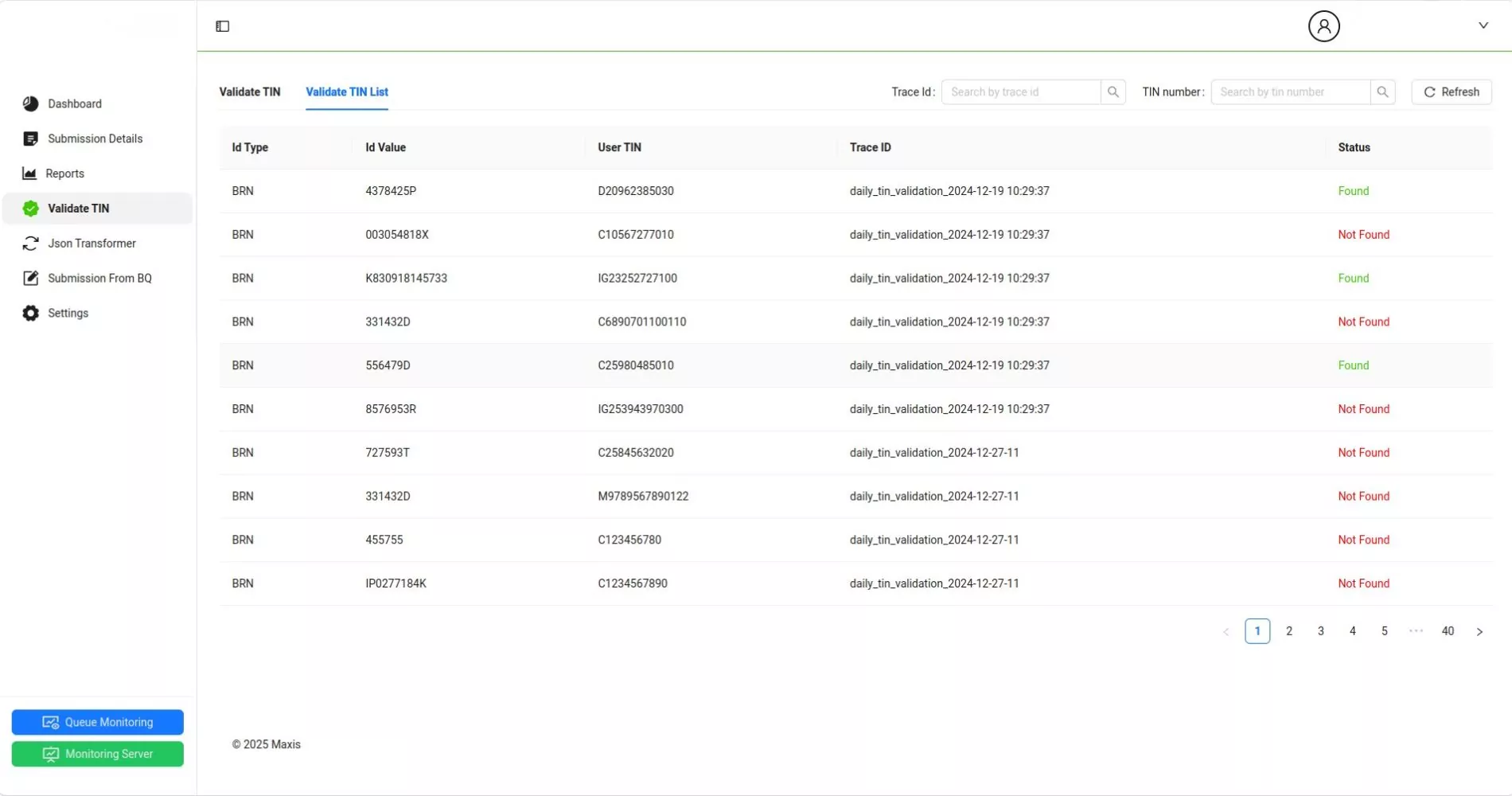
This feature provides a mechanism to validate Taxpayer Identification Numbers (TIN) efficiently, ensuring strict regulatory compliance. The system performs scheduled TIN fetching from the internal business network and cross-references them against the LHDN system. This automated validation process ensures that all customer tax data is accurate before invoice processing begins.
Integration With ERP Systems
e-Invoice Business Portal
e-Invoice Service Monitoring Portal
Customer Service Agent Portal
PDF Document Generator
Audit Logs
User Experience
Development Timeline
Phase 1
Initial Discovery and Planning
3 Weeks
Design Phase
1 Week
Development
8 Weeks
Testing and Quality Assurance
4 Weeks
Deployment & Post-launch Support
4 Weeks
Phase 2
Initial Discovery and Planning
4 Weeks
Design Phase
4 Weeks
Development
16 Weeks
Testing and Quality Assurance
4 Weeks
Deployment & Post-launch Support
6 Months
Client Testimonial










Start Your Custom Software Journey Today