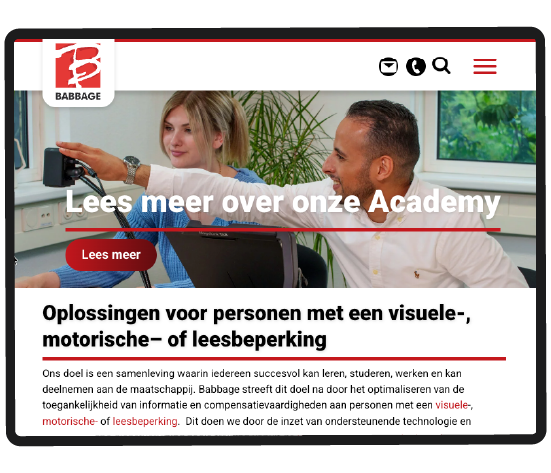
Babbage is a Dutch assistive technology solutions company. They focus on helping people with visual, motor, and reading impairments. Their mission is to help these individuals participate fully in work and education.
They provide specialized tools that make digital information accessible to everyone. Babbage also supports other organizations in meeting strict accessibility standards. They manage a wide range of hardware tools and provide training services for their users.
Project Overview
Every specialized hardware product needs a reliable way to connect with a computer. Babbage wanted to ensure their assistive devices could communicate flawlessly with user laptops via a USB connection. They needed a partner who understood low-level system programming and hardware integration. To verify Vivasoft’s technical depth, the client proposed a focused demo project.
Vivasoft accepted the challenge to build a secure communication bridge. The project required the development of a client component, a server component, and full technical documentation. A major hurdle was that the actual proprietary hardware was not available for the test. Vivasoft solved this by using Raspberry Pi and Orange Pi boards to simulate the client’s devices. The engineers wrote system-level C++ code to manage the serial communication between the hardware and the laptop.
To ensure the connection was safe, the team implemented a semantic authentication process. They successfully verified the link by initiating and exchanging dummy data between the simulated device and the server. This project proved that Vivasoft could handle complex hardware-software integration. Vivasoft delivered a working prototype that met all technical requirements. Babbage now has a clear technical roadmap and the confidence to move forward with their final product development.
Technologies Used
C++
Raspberry Pi
Orange Pi
Challenges faced by the Client
Babbage needed to bridge the gap between their proprietary hardware and modern user devices while verifying a new technical partner.
1. Capability Verification
Babbage needed to confirm that Vivasoft possessed the high-level system programming skills required for their specialized industry.
2. Hardware Connectivity
The client required a stable method to exchange data between a specialized assistive device and a server via USB.
3. Restricted Information
Because this was a test project, the client provided limited details about their final proprietary hardware.
4. Information Delivery
Babbage faced difficulties in ensuring their technology could deliver accessible information across different digital platforms.
Solutions by Vivasoft
Vivasoft developed a robust simulation and communication framework to demonstrate their system programming expertise.
1. Hardware Simulation
Vivasoft used Orange Pi and Raspberry Pi to mimic the client’s proprietary devices. This allowed for testing without the final hardware.
2. Low-Level Programming
The team used C++ for serial device programming. This ensured a reliable connection between the simulated device and the user’s computer.
3. Secure Authentication
Vivasoft implemented semantic authentication. This process verified both devices before any data exchange occurred.
4. Comprehensive Documentation
Vivasoft created detailed technical guides for the client component and server component. This provided a clear roadmap for the client.
Outcomes of the project
The successful completion of the demo project established a strong foundation for a future partnership.
Successful Capability Test
Vivasoft successfully demonstrated their ability to handle low-level C++ programming for medical-grade technology.
Verified Data Exchange
The connection between the simulated client device and the server worked perfectly. Data moved across the USB link without errors.
Ready-to-Use Documentation
Babbage received a full set of technical documents. These files explain how to replicate the connection in their final product.
Scalability Proof
The use of Pi devices proved the software could work on small, portable hardware. This is vital for Babbage’s assistive tools.
Team Involvement
Resources
Count
Backend Developers (System Programming)
2
Project Supervisor
1
Core Features of the Software
The project focused on the essential communication protocols needed for assistive technology devices.
Serial Communication Bridge
This feature allows a hardware device to send data to a computer through a standard USB connection.
Dummy Data Initiation
Vivasoft built a testing module that sends sample data packets. This confirms the connection is stable and active.
Semantic Authentication
This security layer ensures the device and the server recognize each other correctly before sharing information.
Cross-Device Connection
The software allows a client-side device to interact with a server-side component on a standard work laptop.
Development Timeline
Project start time
Dec 2024
1
Project End time
Jan 2025
2
500+ companies rely on
our top 1% talent to scale
their dev teams.
Scale Your Assistive Tech with Vivasoft
Vivasoft creates high-performance software for specialized medical hardware. They solve complex connectivity issues for assistive devices. Contact Vivasoft to develop your next hardware integration project.