Staff augmentation is a flexible outsourcing model where businesses temporarily embed pre-vetted external professionals directly into their existing teams. To make this work effectively, businesses partner with a specialized vendor who sources and deploys the right talent directly into their operations.
Depending on business needs, you have the flexibility to choose from short-term, long-term, project-based, or skill-based augmentation models. Similarly, staff augmentation pricing structures also vary based on time-and-materials, monthly retainer, dedicated team, project-based, and hybrid models. These options allow you to choose the most suitable engagement and pricing model for your project scope, timeline, and budget.
Businesses take advantage of faster hiring, access to specialized talent, and scalability with staff augmentation. Though, there are challenges in staff augmentation, including security risks and communication gaps. This guide provides a complete overview on how staff augmentation works, so you can make informed decisions when scaling your team.
What Is Staff Augmentation?
Staff augmentation is a specialized hiring model in which companies hire external professionals under their own management for a defined duration. The core purpose of this model is to fill skill gaps or address capacity needs as they arise.
Throughout the staff augmentation process, it is likely to integrate the external professionals into operations directly. However, the organization maintains full control over daily tasks and project workflow. Also, the vendor handles employment, payroll, and legal compliance.
What Are the Types of Staff Augmentation?
Staff augmentation comes in different forms. Each of the following staff augmentation types is designed for a specific business situation.
- Short-term augmentation: Short-term augmentation model mainly covers urgent needs when the company requires expert help. These needs may arise during product launches, compliance deadlines, or sudden team gaps.
- Long-term augmentation: The long-term augmentation model is for companies requiring integration specialists or often needing assistance for any ongoing long-term projects, usually from six months to a few years.
- Onshore vs. offshore staffing: Onshore staff augmentation is all about hiring specialists within the same country to fix time zone hurdles and cultural differences. In offshore staff augmentation, companies bring in global talent and integrate them into existing workflows.
- Skill-based augmentation: Skill-based augmentation approach focuses on hiring talent with specific skills that are lacking within the existing team.
- Individual staff augmentation: Individual staff augmentation means hiring a specialist to solve a specific problem or task. They work directly with the internal team, focusing on clearly defined responsibilities.
- Team augmentation: Team augmentation allows a company to hire a small external team instead of one person to handle larger projects or to complete multiple tasks at the same time.
- Project-based augmentation: In a project-based augmentation model, companies hire an external team of professionals to handle an entire project from start to finish instead of filling small skill gaps.
How Does Staff Augmentation Work?
The staff augmentation process mainly starts with identifying a specific skill gap analysis that needs to be filled for any technical requirements for a project. Once the core needs are defined, companies then start sourcing and vetting specialized talent to match the existing team’s workflow.
After completing interviews and onboarding, the external professionals join the internal operations. They work under direct company supervision and complete tasks using their tools and methodologies.
What Is the Staff Augmentation Process Flow?
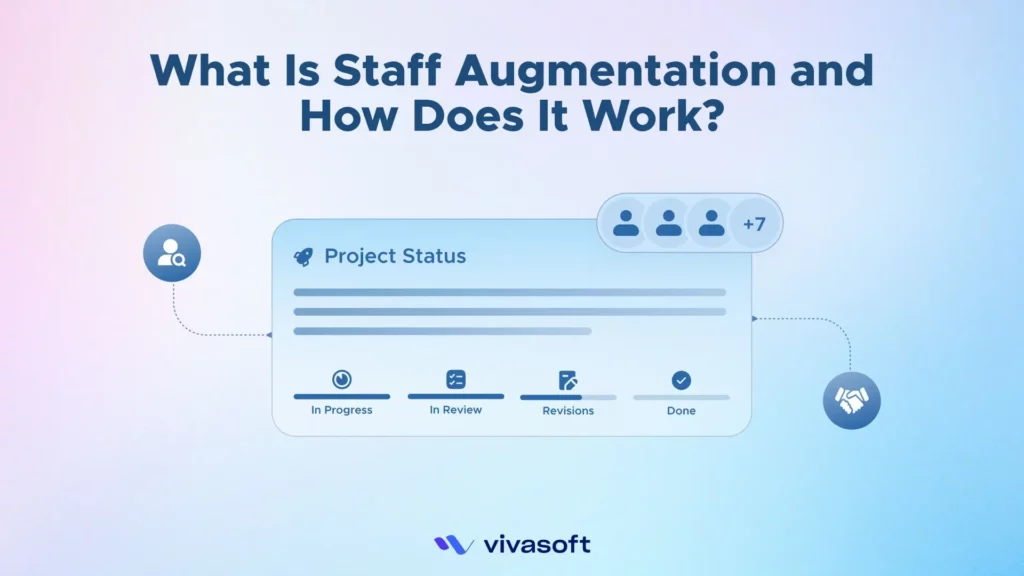
The staff augmentation process flow includes the following key stages:

1. Define Your Talent Needs
As a first step, companies conduct a precise audit to identify specific skill gaps in the team and assess project deadlines. They then define the required technical stack and seniority level. Managers establish clear objectives to ensure the incoming talent aligns with project milestones.
2. Choose the Right Staffing Partner
Next, managers assess potential staffing partners based on their industry reputation and compliance standards. The goal is to find a staffing partner who can match the company’s needs and support smooth project execution with minimal onboarding delays.
3. Screen and Select the Right Talent
Companies interview candidates to ensure a strong fit for the role. They assess both technical and communication skills to support effective collaboration. Managers also review past experience before finalizing the selection.
4. Onboarding Augmented Staff
New team members are now onboarded directly under the company’s management. They get access to the company’s tools, systems, and project resources. Managers guide them on workflows and security rules.
5. Project Execution and Management
As part of the team, augmented staff join meetings, follow updates, and complete assigned tasks. Managers monitor performance and ensure the project stays on track.
6. Offboarding
When the project ends, the company formally concludes the engagement. Many staff augmentation providers also offer post-project support if any issues arise.
What Are the Requirements for Staff Augmentation?
The requirements for staff augmentation are as follows:
- Clearly defined project scope and goals
- Specific skill requirements and technical stack
- Defined duration of engagement
- Budget allocation for external talent
- Access to necessary tools, systems, and codebases
- Strong NDA and security agreements in place
- Proper onboarding and workflow process
- Assigned internal manager or project lead
- Clear communication and reporting channels
Can Companies Interview and Approve Augmented Staff Before Onboarding?
Yes, companies can interview and approve augmented staff before onboarding. Reputable staff augmentation companies always offer shortlisted candidate profiles so that the client can review them perfectly. This allows companies to conduct full technical interviews and assess the skills required for the specific project. After selecting the best-fit candidate, the company confirms approval and completes vendor agreements. Onboarding preparations then begin immediately.
How Does Staff Augmentation Work for Different Industries?
The working principle of staff augmentation is typically different based on industries and their requirements. Let’s break down how staff augmentation differs across industries:
IT and Software Development
In the IT staff augmentation process, companies mainly hire developers, DevOps engineers, or QA specialists to integrate into their existing workflows. This could be sprint cycles or handling ongoing development work. They contribute to existing codebases and follow internal workflows to support ongoing product development.
Healthcare
Healthcare providers often integrate specialized staff through augmentation, mostly to reduce the administrative load and improve operational efficiency. These professionals mainly work alongside in-house clinical and administrative teams. They help ensure compliance with healthcare regulations, as well as streamlining daily operations to improve patient care and overall efficiency.
Financial Technology or FinTech
FinTech companies go for staff augmentation to speed up their product development, while maintaining strict regulatory compliance. For this purpose, they may need to onboard specialized professionals. This includes blockchain developers, software developers, cybersecurity engineers, and DevSecOps specialists, who integrate directly with in-house teams. This ensures faster delivery while maintaining strong security and compliance during product launches and audits.
Higher Education
Institutions often use staff augmentation to address skill gaps and manage increased workloads. The professionals in the education sector include IT support specialists, data analysts, administrative assistants, and finance & accounting staff. These professionals help in digital learning systems and student information platforms to ensure a reliable academic environment.
Investment and Regulatory Affairs
Organizations need subject matter experts to handle intensive data modeling and compliance auditing during market shifts. For instance, augmented professionals work with the research teams and analyze market trends. They ensure investment strategies remain compliant with global regulations.
E-commerce & Retail
Companies use staff augmentation to handle platform development. Often, they hire experts for UX improvements and order management systems. As workloads increase, internal teams often struggle with fixing bugs, releasing products faster, or system optimization. After integration into existing workflows, they assist in different purposes. This would be payment integration, performance optimization, and ensuring platform stability.
What Pricing Models are Used in Staff Augmentation?
There are different pricing models used across staff augmentation processes, based on engagement type and project duration. The pricing models used in staff augmentation are given below.
Time and Materials
The time and materials model is basically an hourly model where you just pay for the actual hours worked by the augmented staff. This is ideal when the project goal is not clearly set, and there is uncertainty. With this flexibility, you can adjust tasks as needed while maintaining better control over the budget and timeline.
Monthly Retainer
A fixed monthly fee is charged for dedicated developers or teams under this model. It works well for long-term projects when you want ongoing support for development. It is most suitable when requirements are continuous and predictable.
Project-Based
The project-based model operates on a fixed price for the entire scope of work. It works best when goals are clearly defined, and delivery is expected within a set timeline and budget. This model reduces financial risk but offers less flexibility for changes.
Dedicated Team
A dedicated team model assigns full-time professionals who work exclusively on a single project. It is ideal for long-term product development when you need consistent support and deep integration.
Hybrid
The hybrid model combines two or more engagement models, such as hourly, fixed-price, or dedicated teams. It is ideal for complex projects where different phases require different approaches. This model offers flexibility, allowing organizations to adjust costs and resources as project needs evolve.
What Are the Benefits of Staff Augmentation?
The benefits of staff augmentation are given below.
Cost Efficiency
Using staff augmentation, companies pay only for the work delivered, which reduces overhead costs tied to full-time hiring. This approach can lower costs by up to 30–50%, as it eliminates expenses like permanent salaries and employee benefits.
Faster Hiring
Instead of waiting weeks or months for recruitment, companies get direct access to pre-screened professionals quickly. Thus, they fill their urgent skill gaps with the right talent instead of going through a long hiring process.
Flexibility & Scalability
Staff augmentation allows teams to scale during high-demand sprint cycles. It provides access to expertise for product launches, tight deadlines, or new feature development. As demand decreases, teams can scale down without long-term commitments. This flexibility helps organizations respond quickly to changing needs.
Access to Global Talent
According to research, the number of companies struggling to find skilled workers increased from 36% in 2014 to 75% in 2024. This challenge increases over time when you are stuck in local hiring markets. Offshore staff augmentation allows companies to access talent from different regions. These professionals offer specialized skills that may not be available locally.
Filling Skill Gaps
When the in-house team lacks specific expertise, businesses can integrate the right professionals instantly. Instead of wasting time training existing employees, you can bring in specialists who already have hands-on experience.
Reducing Operational Overhead
Staff augmentation reduces operational overhead by shifting administrative tasks such as recruitment, onboarding, and payroll to the provider. This streamlines workflows, minimizes delays, and improves overall productivity.
No Recruitment Overhead
Staff augmentation helps eliminate every cost related to traditional hiring. This includes recruiter commissions, job board subscriptions, background checks, and long weeks of HR processing time. This allows companies to bypass much of the traditional hiring process and reduce recruitment costs.
What Are the Challenges of Staff Augmentation?
Staff augmentation offers strong advantages, but it is not without challenges. Here are common challenges tech leaders face:
Communication and Collaboration Gaps
When teams work across different time zones or follow different working styles, miscommunication can occur. In some cases, this can slow down workflows and impact overall ROI.
Onboarding and Integration Time
Integrating new team members into existing tools, workflows, and team dynamics can take time. Managers often need to invest additional effort in onboarding, which may temporarily slow productivity.
Knowledge Retention When Engagement Ends
When augmented staff leave, critical knowledge such as undocumented decisions, system logic, and workflows can be lost. Without proper documentation and handover, teams may struggle to continue work smoothly or resolve issues later.
Managing Quality And Performance Remotely
Tracking quality and performance can be challenging with remote teams. Without clear goals, KPIs, and monitoring systems, issues may go unnoticed. This can lead to a gradual loss in work quality.
Security And Confidentiality Risks
Security risks can arise when external professionals are given access to internal systems and sensitive data. Without strong security measures and clear access controls, confidential information may become vulnerable to breaches or misuse.
How to Implement and Manage Staff Augmentation?
Implementing staff augmentation is not just about hiring the right people. It also requires setting up the right systems to ensure external teams can work effectively from day one. Here is how to implement staff augmentation and manage it:
- Choose a staff augmentation company: First off, select the right staffing partner. Look for their experience in similar projects and their technical expertise aligned with your requirements.
- Writing a strong SOW and contract: Before starting, ensure a clear agreement where you clearly explain what needs to be done. It should also mention how success will be measured, who owns the work, and how data and access will be handled. This saves the company from delays and legal issues.
- Managing augmented staff/teams day to day: Coordinate the external team like your in-house team members. Properly onboard them, include them in meetings and sprint planning, and ensure they understand clear goals. Maintain regular communication to keep alignment.
What Type of Contract Is Used in Staff Augmentation?
Staff augmentation usually works through a service-based contract rather than a traditional employment agreement. Depending on the engagement, it can be hourly, monthly, or project-based. These contracts typically cover scope, duration, billing terms, along with NDAs and IP protection.
How Is Performance Measured in Staff Augmentation?
Different KPIs are used to measure the actual performance of the staff augmentation team. For instance:
- Cost savings
- Return on investment (ROI)
- Cost per feature
- On-time delivery rate vs deadlines
- Quality metrics
- Project net profit margin
- Client satisfaction index
- Speed of onboarding
- Team productivity/output efficiency
How Is Confidentiality and Data Security Handled With Augmented Staff?
Companies follow strict security and legal protocols when onboarding augmented staff to protect sensitive data. This typically includes:
- NDAs where the staff augmentation company comes into an agreement not to share any company-sensitive information with others.
- IP assignment agreements where all the work done by external staff belongs fully to the company.
- Role-based and minimum-necessary access control, where each staff member is given only the permissions required to access specific systems and tools needed to perform their tasks.
What Are the Differences Between Staff Augmentation, Full-Time Hiring, and Outsourcing?
Staff augmentation, full-time hiring, and outsourcing are three different ways companies build and manage teams. Here’s how they differ:
| Factor | Staff Augmentation | Full-Time Hiring | Outsourcing |
|---|---|---|---|
| Employment type | Temporary external experts | Permanent employees | External team/company |
| Control | Full control (you manage work) | Full control (in-house team) | Limited control (vendor manages work) |
| Team integration | Works inside your team | Fully part of your team | Works separately from your team |
| Hiring speed | Fast (pre-vetted talent) | Slow (full recruitment process) | Fast to medium (depends on vendor) |
| Cost structure | Pay for time/skills used | Salary + benefits + long-term cost | Fixed contract or project-based cost |
| Best for | Skill gaps, scaling quickly | Long-term stable workforce | End-to-end project delivery |
When Should a Company Choose Staff Augmentation Over Full-Time Hiring or Outsourcing?
Staff augmentation is the right method to choose when you prefer cost efficiency with full control without long-term hiring. Here are some situations when a company should choose staff augmentation over full time hiring or outsourcing:
- When you need experts quickly: Staff augmentation is ideal for short or mid-term projects where you need skilled professionals fast.
- When you want direct control over work: Staff augmentation allows you to manage and direct the work of external specialists.
- When you have specific skill gaps: You can easily fill gaps in specialized skills across areas like software development, digital marketing, design, or finance without hiring full-time employees.
- When you need to scale your team: You can expand your team capacity quickly to meet deadlines while avoiding the cost and time needed for the permanent hiring process.
- When handling high-pressure initiatives: Staff augmentation is especially useful during time-sensitive phases like product launches, feature rollouts, or market expansion efforts.
Is Staff Augmentation Cheaper Than Hiring Full-Time Staff?
Yes. Staff augmentation is definitely more affordable compared to hiring full-time staff. Through staff augmentation, you only pay for the specific time and skills used.
You can easily avoid salaries, benefits, and recruitment costs. By eliminating long-term employment overhead, you can maintain full control over your project and stay within budget.
Why Should You Choose Vivasoft Limited as Your Staff Augmentation Partner?
Vivasoft Limited is a top-rated custom software development company, built on a foundation of 300+ world-class engineers. With 10+ years of delivery excellence and a proven success record with 50+ global brands, the company is a trusted partner for your next staff augmentation engagement.
The company deploys top-experts, pre-vetted top 1% technical talent that integrates directly into your team. Here is what makes Vivasoft Limited stand out as your staff augmentation partner:
- Seamless integration into existing agile workflows.
- Flexible engagement models.
- Dedicated account managers for smooth execution.
- Proven delivery experience across SaaS, Fintech, Healthcare, Gaming, and E-commerce.
- Cost-efficient access to high-quality engineering talent.
- Strong IP protection with NDA-based agreements.